The Vegetative Phase of the Cannabis Plant: How to Build an Explosive Structure!
Welcome everyone to this new article of our Cultivation Manual! After getting our hands dirty choosing the best substrate for growing cannabis and looking at the differences between pot cultivation vs hydroponics and aeroponics, and after safely getting through the highly delicate germination stage, today we get into the heart of the game. We are talking about the cannabis vegetative phase, the true engine of the plant.
Grab pen and paper, get comfortable, and clear your mind of distractions: today we mean business!

What the Cannabis Vegetative Phase Really Is and Why You Cannot Make Mistakes
The vegetative phase of cannabis plants is that magical period of time that falls exactly between the birth of the seedling and the start of the actual flowering stage. At this precise moment, the plant stops being a fragile newborn and turns into an athlete: it concentrates all its immense energy on the wild development of deep roots, hand-sized leaves, and robust branches.
This requires special attention from you. Reaching this point in the cycle while dragging along watering errors or nutrient deficiencies means only one thing: condemning the plant to severe stress, resulting in a slowdown or, worse, a total development lockout. And in our world, a lockout means losing precious days that no one will ever give back to you.
Looking at the grow room, you will notice that the plant tends to grow much faster than in the early days. We are talking about an average rate of a new set of leaves every three days!
- Indoor space warning: If you grow indoors, you must plan your space to the millimeter.
- Plan pruning: It becomes mandatory to study where and when to cut to avoid overcrowding the cultivation space, which brings mold problems or pest attacks.
- Manage the photoperiod: Remember that until you flip the light timer to 12 hours of light and 12 hours of darkness, your plants will continue to grow, occupying every free centimeter.
If you don’t keep this instinct of the plant in check, the initial enthusiasm of seeing it grow big and strong will quickly turn into despair! The good news? If the plants show no visible problems, the vegetative stage is the least delicate phase of the entire cycle. It is flexible: any mistake made by the grower can be resolved and forgiven with a couple of right moves.

When Does the True Vegetative Stage Begin? Parameters and Secrets
But when can we say that the vegetative phase has officially begun? It usually happens around the third week of life, precisely when the plant has developed its fourth or fifth set of true leaves.
This is where the magic happens: at the level of each new internode (the point where the main stem meets the leaf petiole), you will see new shoots emerge. Those are the secondary branches, the future bearers of those shimmering, heavy marijuana buds you dream about at night!
For us at Annibale, this is absolutely the best time to intervene with a small, targeted apical topping. Cutting the main apex pushes the plant to distribute its hormones and energy to the side branches. Sure, you’ll pay the price of a few extra days of vegetation on the schedule, but in exchange, you’ll get a bushy structure and a significantly more abundant harvest.

To keep the plant running without hesitation, you must lock down these environmental parameters in your grow room:
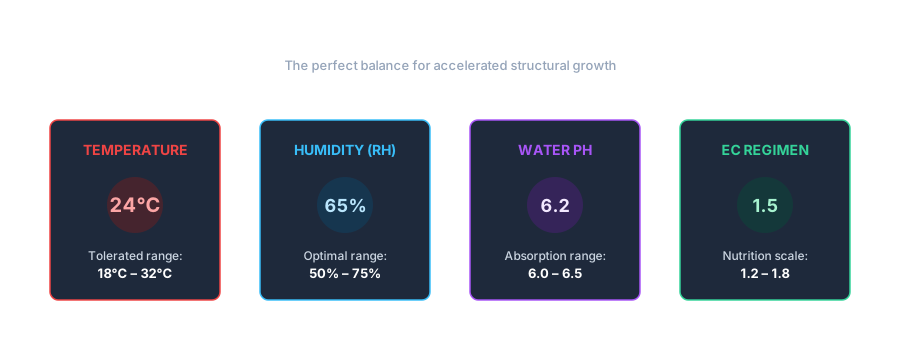
- Temperature: Stay between 18°C and 32°C. The absolute ideal for photosynthesis is a middle ground, around 24-26°C.
- Relative Humidity: Push it high, between 50% and 75%. This helps the leaves transpire without overstraining the still-young roots (the VPD chapter is fundamental).
- EC (Electrical Conductivity): The electrical conductivity value of the irrigation water must stay between 1.2 and 1.8. Increase it gradually as the plant grows.
- Water pH: Strictly between 6.0 and 6.5 if you grow in soil, to ensure that the plant can absorb every single drop of nourishment.
- Lumens and Spectrum: At least 4500+ Lumens per plant, preferring cool/blue light lamps (6400K) that keep internodes close and compact (we recommend MH lamps).
- Primary Nutrient: In this phase, the plant has an insatiable hunger for Nitrogen (N). Phosphorus and Potassium are still needed, but in significantly smaller quantities.
End of the Vegetative Phase: The Moment of the “Switch”
When the plants have reached a height of about 30-50 cm and have filled the grow room space evenly, it is finally time to shift gears and transition to flowering.
If you use the SOG (Sea of Green Technique) cultivation system, the golden proportion is to make the switch when the plants have occupied about three-quarters of the available space. Don’t be late with changing the light cycle! Remember that during the first weeks of flowering, plants can easily stretch 5 centimeters a day, transforming your room into an impenetrable jungle.
Browsing the web, you will surely come across readings from sacred pillars of cultivation like Jorge Cervantes or Greg Green. Many of these authors advise against inducing flowering until the plant spontaneously shows its pre-flowers, a sign of its sexual maturity. The risk, according to the theory, is causing a metabolic stress that could lead to rare cases of hermaphroditism.
However, our practical experience tells us that if your plants are in perfect health and have suffered no trauma, you can change the timer to 12/12 in total safety. Once the lights are flipped, the plant will take about 7–10 days to show the first primordial pre-flowers at the level of the main internodes.

Tips and Tricks of the Trade and Light Management
We close with a parade of practical advice straight from the Annibale counter, stuff that will turn your cycle around if applied wisely:
- Clean the lower branches: Mercilessly prune the very first small branches born at the base of the plant, right above the first single leaves after the cotyledons. They will never receive enough light and only strip precious energy away from the upper branches.
- Watch out for Nitrogen over-fertilization: Nitrogen is crucial, but excess is a silent killer. You will end up with dark green leaves curled into a “claw”, weak tissues, and a growth stunt. If you overdo it, run to do a root flush with clean water to clean out the substrate.
- Study manipulation techniques: Don’t just watch the plant grow straight like a pine tree. Read, dig deeper, and apply selective defoliation, LST (Low Stress Training), and apical pruning (Topping) to master cannabis cultivation and spread a uniform green carpet under the indoor grow lamps.
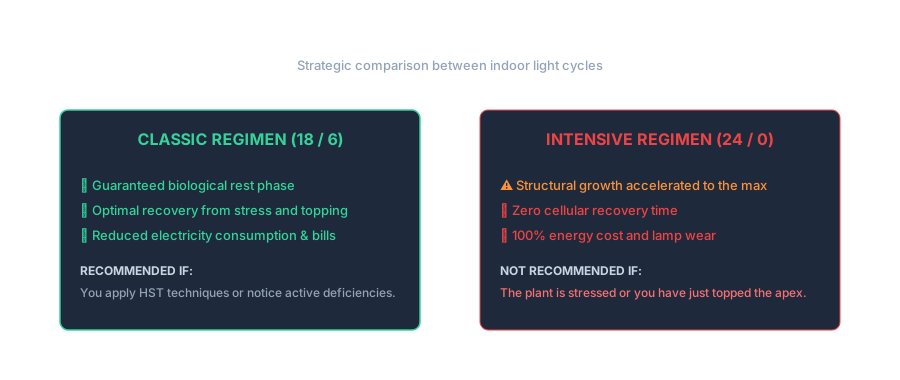
One final note on the photoperiod for those who wish to learn how to grow cannabis indoors: many growers choose to keep the lights on 24 hours a day during the vegetative stage. What do we think? True, it accelerates development impressively, but there is a price to pay beyond the electricity bill. Without hours of darkness, the plant has no rest period to recover from intense traumas or stresses.
For this reason, we strongly discourage the 24/0 cycle if you plan to apply aggressive pruning or if you are fighting obvious nutrient deficiencies. Give your plants the proper rest, and they will thank you!
And for this chapter as well, we have examined what is of primary importance in the cannabis vegetative phase. If you liked the article, keep following us into the next chapter regarding the delicate cannabis flowering phase, week by week!
Greetings from the Annibale Team, see you at the next article!
Davide, CEO, Founder & Geneticist