What is VPD and How to Set It Indoors to Grow Marijuana
Welcome to this new “indoor professionals” chapter of Annibale Seedshop’s blog about VPD in indoor cannabis cultivation!
Today we’re talking about one of those acronyms that might seem like NASA engineering stuff at first… but then you discover it’s the difference between healthy, compact buds and a grow room that feels like a sauna with mold lurking: the famous VPD parameter.
If you’ve ever had:
- plants that, when watered, drink too much or too little,
- leaves that burn under LED lights,
- slow growth even with perfect nutrition,
- flowers that become a magnet for botrytis in the final flowering stage…
Very often, it’s not the fertilizer’s fault, nor the grower’s per se, but the indoor climate. And the most practical and modern way to read the indoor climate is precisely that: VPD.
VPD explained simply for everyone
VPD stands for Vapor Pressure Deficit, or—simply translated—how much the air “wants to pull water” from the leaves.
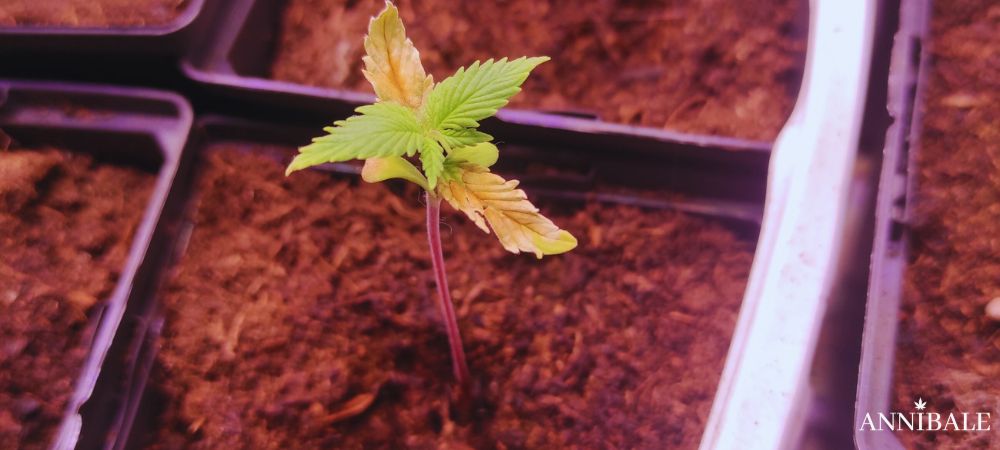
- If the VPD is too low (air too humid and too cold), the plant transpires less, drinks less water, absorbs less light, and essentially remains “sluggish and depressed.”
- If, however, the VPD is too high (air too dry and too hot), the plant transpires too much, drinks too quickly, experiences water stress, and can close its stomata (bye-bye CO₂, bye-bye explosive growth!).
The VPD is therefore the true thermostat for marijuana plant transpiration, and in biology, transpiration is the very engine of the plant, allowing it to:
- absorb nutrients properly,
- promote gas exchange,
- increase vegetative vigor,
- manage environmental humidity during the flowering phase of cannabis.
So, essentially, if the VPD for cannabis cultivation is correct, all the other parameters become easier to manage.
Cannabis Leaf Temperature: The Thing Almost All Growers Get Wrong
Here comes the more professional part of the topic, dedicated to the most demanding weed growers, but we want to explain it simply.
Follow us carefully: with LEDs, leaf temperature is very often lower than air temperature (because LEDs emit less infrared radiation than older lamps).
This translates into:
- You read 28°C on the grow room’s thermo-hygrometer,
- but in reality, the plant’s leaf temperature reads 24°C,
- and here you discover that the actual VPD is different from what you thought.
Bottom line: if you want to correctly apply the VPD concept to your indoor cannabis grow, measure leaf temperature (even with a cheap infrared kitchen thermometer) and take that as a true parameter (or at least a typical offset of 1–2°C).
Recommended VPD table for specific phases
These ranges are the ones that appear consistently in modern technical guides and references used by “serious” growers (even when discussed on forums like iCMAG, this is the gist of it).
stage | VPD target (kPa) | Correct “sensation” in grow box | Objective |
|---|---|---|---|
| Clones & Seeds | 0,6 – 0,9 | High humidity, protect plant | Rooting |
| Vegetative stage | 0,8 – 1,0 | Live habitat but not dried | fast growth, open leafs |
| First flowering stage | 0,9 – 1,1 | less humidity | internodes check + fast growth |
| Full flowering | 1,1 – 1,3 | more dry and stable air | golf balls buds + zero molds |
| Last flowering stage | 1,1 – 1,4 | dried, “crunchy” but not desertic | anti-botrytis + flower maturation |
There’s no need to go crazy trying to nail down a specific number: instead, focus on staying within the ideal range, with stability. When growing indoor cannabis, stability beats perfection 3-0!
5 Tips on How to Correctly Set Your Indoor VPD
Choose the Ideal Temperature and Make It a Standard
For most modern indoor LED grows, staying within a range of 24–27°C during the vegetative stage and 21–24°C during the flowering stage is a solid guideline for a happy grow.
Adjust Humidity to Stay in the Ideal VPD Range
Don’t make the novice mistake of measuring humidity “by instinct.” The logical rule here is simple:
- The higher the temperature, the higher the humidity must also be to avoid skyrocketing the VPD;
- The lower the relative humidity percentage during flowering, the more you protect your flowers from molds like botrytis.
Pay attention to the transition between the vegetative and flowering phases of cannabis.
We at Annibale Seedshop & Genetics see it all the time. Indoor weed growers who, in the space of a day:
- go from the humid and wet, “jungle”-style vegetative phase
- to a dry, “desert”-style initial flowering phase.
The result is that leaves curl, leaf stomata close, and uneven and constant stretching occurs over time, causing stressed plants to tend to protect themselves.
It’s therefore better to opt for a more gentle transition: over 4–7 days, gradually lower the ambient humidity and raise the VPD toward the correct values for the flowering phase.
Monitor the indoor microclimate (spoiler: a thermo-hygrometer hanging on the wall isn’t enough).
Week by week during flowering, botrytis doesn’t grow “in the room”: it grows in the substrate and inside the flower, where the air is waterlogged.
It is therefore advisable to:
- Hang a thermo-hygrometer inside the grow room (one hung at the height of the tallest buds, the other on the substrate of the central plant),
- Proper ventilation and extraction,
- Use rotating fans that don’t leave pockets of humid, stale air.
This is why in technical threads on THCFarmer, the topic of VPD is almost always accompanied by the terms “airflow” and “mold“: they are two sides of the same coin.
When nothing adds up: look at VPD first, then the rest
If the cannabis plant:
- feeds little,
- drinks little,
- grows slowly,
- produces burnt tips despite a “normal” EC…
Before changing fertilizers every 48 hours (a classic novice grower’s sport), carefully check whether the grow room falls within the correct VPD parameters listed here.
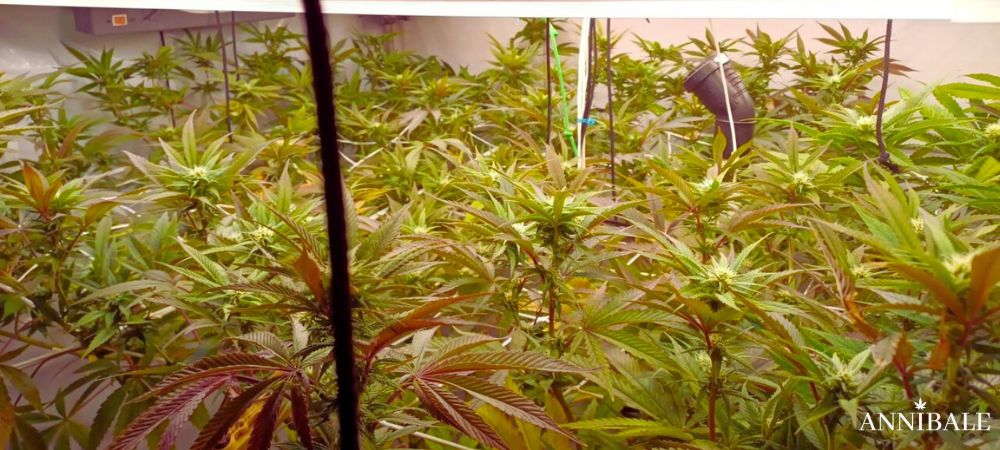
Indoor VPD Examples
- Vegetative stage: 26°C and 60% RH → you’re often in the right zone (VPD around ~1 kPa, depending on leaf temp).
- Flowering stage: 26°C and 40–45% RH → very good range for the final flowering stage (in fact, there’s less risk of mold).
- 26°C and 35% RH → often VPD too high: plants that suck water and become quickly and visibly stressed (a classic example is burnt leaf tips).
3 Common VPD Mistakes (the ones we see most often)
- Too high ambient humidity in late flowering: Yes, the plant may even seem happy until you open a much softer bud and find disaster.
- Incorrect VPD at very high temperatures because it “dries out the humidity”: Yes, it may dry out the humidity… but it stresses the marijuana plant and ruins its terpenes and cannabinoids.
- Ignoring leaf temperature under LEDs: This is the main reason why two growers who start with the same numbers often get very different results.
In conclusion…
If you want to do professional indoor growing today in 2026, VPD is one of the most important concepts to master because it gives you something huge: control over the environment.
And when you control the climate in an indoor cannabis grow:
- the plant drinks more,
- nourishes better,
- grows faster and more vigorously,
- and during flowering, you don’t live with the daily fear of mold.
And this article on the VPD of indoor cannabis ends here. We hope it’s been helpful in your growing setup. See you in the next article!
Best regards from the Annibale Seedshop Team!
Davide V, CEO, Founder & Geneticist