LST Cannabis: The Low Stress Training Cultivation Technique
Friends and customers of Annibale Seedshop, welcome back to our blog! In our previous installment, we dissected the complex geometry of Fimming (FIM), illustrating how a partial 45° cut can induce extraordinary cell multiplication without compromising the structural health of the plant.
In this new chapter of our “Cannabis Cultivation Manual,” we are shifting our approach entirely. Put away the precision scissors and make room for painless physical manipulation: we will analyze Low Stress Training (LST) in detail. Put aside any confusion with psychedelic acronyms like LSD: here we are talking about pure physics applied to botany, where high focus and tactile sensitivity make the real difference between a mediocre harvest and a forest of giant buds!

What Is the Low Stress Training Technique?
Low Stress Training, universally abbreviated as LST, is a structural manipulation technique that involves applying constant but controlled physical tension to the stem and branches. The primary goal is to guide the plant’s growth along a horizontal axis rather than a vertical one.
In common jargon among commercial growers, LST is often reduced to the simple mechanical action of “bending the plant with a string.” In reality, this is a conceptual error. LST is an openly defined biological macro-category: it includes any physical or environmental manipulation that generates enough non-destructive stress to alter the hormonal balance of cannabis without breaking the vascular tissues.

The Hormonal Control of Auxins
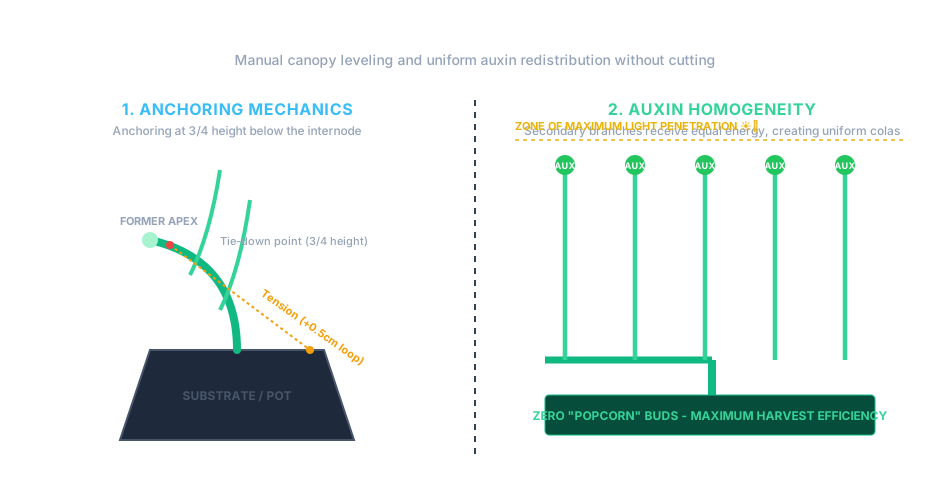
To understand the effectiveness of LST, we must analyze the sap. Cannabis is characterized by very strong apical dominance: the plant concentrates auxin (the growth hormone) at the highest tip to push the specimen toward the sun, while inhibiting the development of the lower branches.
By bending the main stem downward so that the apical bud sits at a lower height than the branches below it, you trick the plant’s vascular system:
- The flow of auxins is disrupted and redistributed perfectly symmetrically across all lateral nodes.
- Every single secondary branch experiences an immediate hormonal spike, taking on the status of a “new apex.”
- The plant halts its vertical extension, transforming into a dense, perfectly leveled bush.
Furthermore, the spectrum of LST covers complementary practices such as controlled and periodic defoliation. By strategically removing small percentages of shaded foliage, the plant undergoes systemic micro-stress. This induces an immune and protective reaction, forcing it to increase trichome density and resin concentration on the exposed buds.
Why Use the LST Technique in Cannabis Cultivation?
The reasons that drive an experienced grower to regularly implement LST in their grow room are manifold, touching upon both security and economic yield.
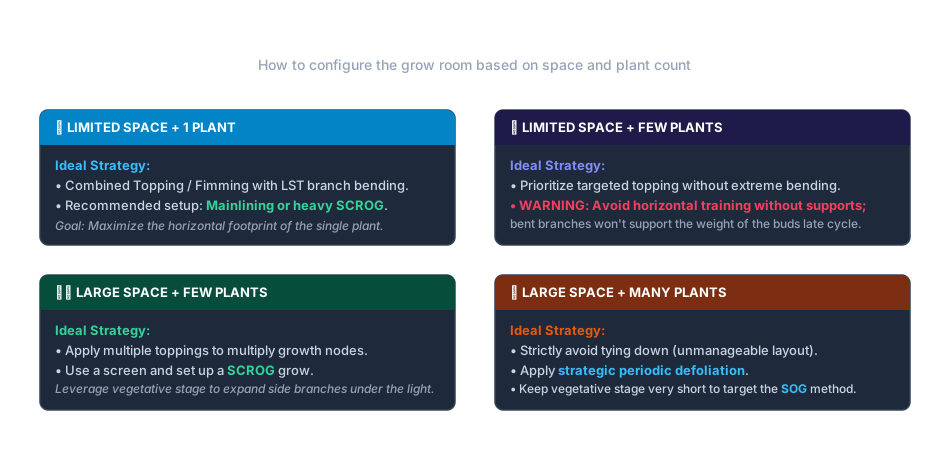
- Privacy Management (Indoor & Outdoor): For those who must grow in urban contexts or spaces where grow box height is limited, reining in vertical development is an absolute necessity. LST allows you to manage plants that would genetically exceed two meters, keeping them below 60-80 centimeters.
- Maximizing the Light Spectrum: In natural growth (conifer-shaped), only the main bud enjoys 100% of the lumens emitted by the lamp, while the lower zones remain in the shade, producing insubstantial flowers (so-called “popcorn buds”). LST levels the cultivation space by creating a uniform horizontal plane. All buds will be at the exact same distance from the light source, optimizing photosynthesis.
- Synergy with Advanced Techniques: LST is the core engine of Mainlining, an elite technique that combines drastic pruning (Topping) and geometric ties to structure the plant like a symmetrical candelabra, ideal for producing true “fragrant giants” both in the grow room and out in the open field.

When to Use LST in a Cannabis Grow?
Biological growth timing determines the success of this technique. Since these are structural manipulations, the plant tissue must be plastic and not yet lignified.
- Optimal Time Window: Geometric tying and bending of the main stem can be started from the third week of the vegetative phase, or at least when the plant has stably developed its first 4-5 turgid internodes.
- Defoliation Management: As for the targeted removal of fan leaves, it is mandatory to wait for the full development of the lateral branches. Defoliating a plant that is too young or not yet structured stalls its photosynthetic capacity, causing a shock-induced metabolic arrest (induced stunting).
The Overcrowding Mistake: It is completely counterproductive to pack in a high number of plants (e.g., 25 plants per square meter) and expect to apply LST techniques or pruning. In high-density scenarios, the plants will shade each other out, canceling out the hormonal benefits. LST expresses its maximum potential when working with fewer specimens managed over large cultivation areas.
How to Apply the LST Technique: The Annibale Seedshop Operational Guide
Putting it into practice requires a gentle touch. The cannabis stem is elastic in the first few weeks, but incorrect or angled pressure can snap the xylem channels, compromising the branch.
The Geometric Tying Method
- The Materials: Avoid bare wire, nylon, or strings that are too thin at all costs, as they risk acting like blades and sawing into the bark. Opt for common cotton kitchen twine or specialized rubber-coated gardening twist ties.
- Base Anchoring (Counter-Tension): Before bending the top of the plant, you must secure the base of the trunk. Tie a string around the first lower internode and anchor it firmly to the rim of the pot in the opposite direction of your main bend. This prevents the subsequent pulling force from uprooting or tilting the root system in the substrate.
- The Main Bend: Wrap a second string around the upper part of the plant, specifically just below a stable internode positioned at about 3/4 of the total height.
- Knot Management: Create a stable loop around the stem, strictly leaving a tolerance margin of at least half a centimeter. The stem will double its diameter within a few days; a knot that is too tight will strangle the plant, choking off the passage of nutrients.
- Securing to the Pot: Gently pull the string downward, curving the stem until it is parallel to the ground. Secure the opposite end of the string by drilling a hole in the rim of the plastic pot, using a stake in the ground (if growing outdoors), or hooking it onto the supports of hydroponic or aeroponic systems.
It will take less than 48-72 hours to witness a magnificent phenomenon: the original apex will curve upward again to seek the light, while all the intermediate nodes of the plant explode vertically, kickstarting the formation of a perfectly flat and dense Cannabis cultivation. We highly recommend this technique to all beginners: it is the safest, most visual, and most exciting way to understand the true physiology of cannabis.

And that’s all for today regarding the LST (Low Stress Training) cannabis cultivation technique. Keep following us in our next article to learn more about the Sea of Green cannabis cultivation method!
Greetings from the Annibale Seedshop Team!
Davide, CEO, Founder & Geneticist