Guide to Cannabis Cultivation Indoor Lamps: Beyond LED Technology
After analyzing in detail how to grow Cannabis indoor in a grow room and how to prepare the best organic substrate for your plants, the crucial dilemma for every grower arises: the choice of lighting. Light and Cannabis go hand in hand; the light spectrum, intensity, and canopy penetration of the crop are the true engines of photosynthesis and resin production.
While technological evolution has crowned the efficiency of modern diodes—explored thoroughly in our vertical guide on Indoor Cultivation LED Lamps—the market still offers traditional and alternative systems that maintain unique advantages in terms of penetration, installation costs, and specific chemical spectrums. Let’s explore the state of the art of HID, CMH, CFL, and Neon technologies, analyzing the field data shared by the largest international grower communities such as ICMag, THCFarmer, and Reddit.

Sunlight vs Indoor Lamps: The Spectrum Challenge
For millions of years, Cannabis has evolved under the perfect spectrum of natural sunlight. The plant is a photoperiod organism (with the exception of Ruderalis variants, which are genetically programmed to flower based on biological age regardless of light hours). The sun offers a continuous flow of PPFD (Photosynthetic Photon Flux Density) and a DLI (Daily Light Integral) value that define the ideal standard.
However, outdoor sunlight is inextricably linked to climate variables, pests, and geographical limitations (especially in Northern Europe or alpine areas, where warm seasons are too short). Indoor cultivation was born precisely to recreate this ecosystem in a controlled manner, allowing the grower to manipulate the light spectrum and photoperiod light/dark cycles (18/6 in the vegetative phase, 12/12 in the flowering phase) to maximize biomass and terpene production.

CFL (Compact Fluorescent Lamps): Solutions for Micro-Growing
CFL lamps are the choice of excellence for small spaces, micro-growing (such as PC grow boxes or space-buckets), and for novice growers operating on a tight initial budget.
- Operation: They do not require external transformers or ballasts; they integrate the electronics directly into the base and screw into common E40 or E27 socket lampholders.
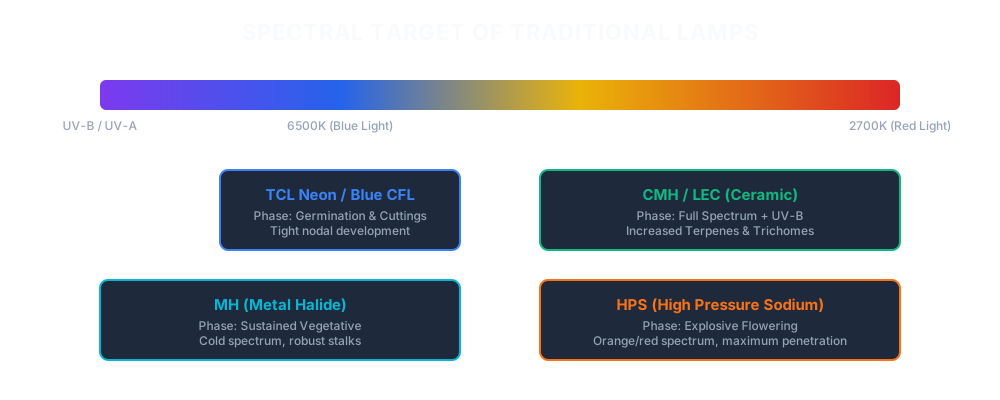
- Available Spectrums: They are mainly divided into 6500K bulbs (blue/cold spectrum) for the vegetative phase and 2700K bulbs (red/warm spectrum) for flowering.
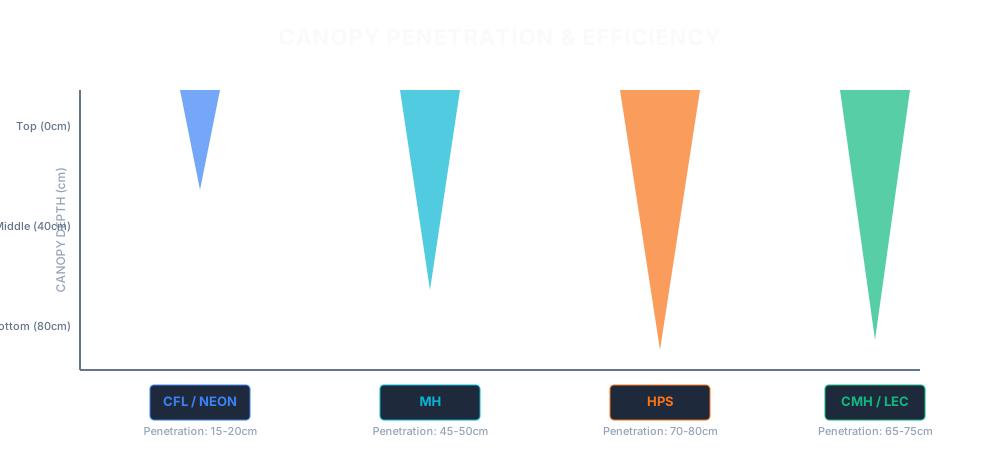
- Advantages and Limitations: They develop very little radiant heat, allowing the lamp to be placed just a few centimeters away from the canopy tops without the risk of light burn. Conversely, reports on ICMag highlight poor light penetration: the light drops drastically beyond 15-20 cm from the source, making them unsuitable for deep canopies. While containing a minimal natural fraction of UV-B rays that stimulate trichomes, the overall lumen output limits their optimal use to the stage of germination, rooting clones, and maintaining micro mother plants.

Neons (TCL Lamps): The Paradise of Clones
TCL neon tubes represent a geometric evolution of CFLs. They are linear, low-consumption tubular systems designed to distribute light intensity perfectly and uniformly over flat surfaces.
- Ideal Application: Seed germination and rooting clones (cuttings).
- Space Management: Generating almost zero heat, they allow for the structure of vertical propagation areas with vertical racking, optimizing grow room space down to the millimeter. Although red-spectrum neon tubes exist, the overall PAR efficiency is insufficient to support commercial flowering; their optimal use stops at the first 10-14 days of the plant’s vegetative life.

HID Lamps (MH and HPS): The Old Lion of Grow Rooms
High-Intensity Discharge (HID) lamps remain the historical standard for commercial indoor cultivation. They are strictly divided into two categories based on the chemistry of their internal gases:
MH (Metal Halide)
The MH emit a crisp white light with strong peaks in the blue spectrum band. This output simulates spring sunlight, signaling the plant to expand its foliar structure while keeping internodal spacing extremely compact. It is the perfect choice for structuring robust mother plants and vigorous bushes ready for a ScrOG setup.

HPS (High-Pressure Sodium)
Characterized by an intense yellow-orange light, HPS lamps simulate the autumn sun. They provide a massive amount of raw lumens and radiant energy that penetrates deep into the canopy, stimulating flower development even on medium-low branches. Legendary 600W HPS kits have raised entire generations of top-shelf buds worldwide.

The Thermal and Electrical Drawback
Despite excellent yields in flowering, technical forums like THCFarmer warn about the hidden costs of HIDs:
- Heat Emission: They transform a large part of energy into radiant heat (infrared rays). They mandate the use of ventilated reflectors (such as the famous CoolTube) connected to powerful air extractors to prevent the temperature from exceeding the critical threshold of 28°C.
- Power Supply: They require an external ballast (magnetic or digital), preferably electronic and dimmable, to stabilize the electrical arc.
- Degradation: HID bulbs lose up to 20-25% of their light efficiency after about 9-12 months of continuous use; they must be replaced regularly to keep harvest parameters unaltered.
CMH / LEC (Ceramic Metal Halide): The Ceramic Revolution
CMH technology (also called LEC, Light Emitting Ceramic) represents the evolutionary link between old HIDs and solid-state systems. By replacing the quartz arc tube of traditional MHs with a ceramic component, these lamps operate at much higher internal temperatures.
- Solar Spectrum and CRI: They generate a pure, natural light with an extremely high Color Rendering Index (CRI). The spectrum is incredibly wide and balanced.
- The UV-B Factor: The most praised feature in High Times laboratories is the massive natural emission of UV-A and UV-B rays. To defend themselves against ultraviolet radiation (perceiving it as high-altitude solar stress), Cannabis plants react by producing a denser layer of glandular trichomes, drastically increasing the concentration of cannabinoids, flavonoids, and therapeutic terpenes.
- Efficiency: They produce more PAR per Watt than standard HPS lamps and generate slightly more manageable heat, although they still require air extraction systems proportioned to the volume of the grow room.

Maximum Efficiency: The Role of Modular LEDs
Although the discharge and thermal emission systems described so far maintain a place of honor in the industry, today’s technology has set an unequivocal direction toward advanced diode systems. Modern quantum board LED panels and multi-bar systems equipped with integrated chips (COBs) offer microscopic control over light spectrum frequencies, drastically cutting electricity bills.
Unlike HPS or CMH, LED systems operate at extremely low running temperatures, eliminating the need for massive extraction systems and preventing the thermal degradation of volatile terpenes. To find out how to calculate the PAR efficiency of diodes, map PPFD values, and choose the highest-performing commercial panels for your space, we invite you to read our strategic guide dedicated to Indoor Cultivation LED Lamps.

Light, Climate, and Home Safety: Golden Rules
Whether your choice falls on the enveloping heat of an HPS or the spectral purity of a CMH, the environmental management of the grow room must adhere to strict rules:
- The 28°C Limit: Temperatures consistently above this threshold instantly degrade volatile cannabinoids (such as THC and CBD) and lighter terpenes, inhibiting cellular growth and leading to root suffocation in the worst cases. Ensure constant, oscillating internal ventilation.
- Electrical Insulation: High-voltage HID ballasts and bulbs work in environments with high humidity levels. Meticulously insulate electrical control units and wiring away from water sources or humidifiers to eliminate short-circuit risks.
- Glass Integrity: Never turn on an HID or CMH bulb that shows micro-cracks or scratches on the outer glass. The accidental explosion of a discharge bulb can compromise the safety of the grow room and cause fires. Always rely on products with testing certifications issued by the manufacturer.
FAQ: Frequently Asked Questions about Cultivation Lamps
What is the concrete difference between Lumens and PAR/PPFD in cultivation?
Lumens measure the amount of light perceivable by the human eye, which is highly sensitive to green and yellow light frequencies. Cannabis plants instead utilize radiation fall within the PAR (Photosynthetically Active Radiation) band, measured in PPFD (micromoles per square meter per second). An HPS lamp emits a lot of visible lumens, but a modern CMH lamp or LED offers a much more balanced and efficient PAR spectrum for chlorophyll photosynthesis.
How often should I replace an HPS or MH bulb?
HID discharge bulbs undergo rapid internal chemical degradation. Even if the lamp still appears intensely bright to the human eye, the emission of useful PAR particles progressively declines. Professional growers on international forums recommend replacing MH and HPS bulbs every 9-12 months of operation (roughly every 2 or 3 complete cycles) to prevent drastic drops in final yield.
Why do UV-B rays emitted by CMH lamps increase resin?
UV-B rays are high-energy radiations that cause cellular stress. The Cannabis plant defends itself against this radiation by increasing resin secretion from the top trichomes; the dense resin layer acts as a true protective “sunscreen.” This controlled stress results in a noticeable increase in the THC percentage and the aromatic spectrum of terpenes. Note: Direct exposure to UV-B rays is harmful to the operator’s skin and eyesight; always turn off the system before entering the grow room.
Can I use an HPS lamp for the entire life cycle of the plant?
Yes, it is technically possible to run an entire cycle with an HPS lamp (especially if it features an Agro spectrum, enriched with a small fraction of blue). However, if you use a classic HPS in the vegetative phase, the lack of blue frequencies will cause severe internodal stretching, causing the plant to develop thin stalks and weak branches. For optimal growth, it is always preferable to use MH bulbs in the first 30 days and switch to HPS at the photoperiod change.
What is the difference between a magnetic and an electronic ballast for HID lamps?
Old magnetic ballasts are heavy, produce intense heat, consume passive energy, and generate a micro-flickering of light that fatigues plant photosynthesis. Digital electronic ballasts are more efficient, do not emit excessive heat, eliminate flickering while extending bulb life, and frequently integrate dimmers to adjust the lamp’s power (e.g., 250W, 400W, 600W) based on the growth stage of the plants.

That’s all for this chapter on Indoor Cannabis Cultivation Lamps! Keep following us for our next chapter dedicated to how to adjust pH for growing Cannabis!
Greetings from the Annibale Seedshop Team, until next time!
Davide, CEO, Founder & Geneticist