Airflow & Indoor Microclimate in Cannabis Cultivation
How to Prevent Botrytis and Powdery Mildew During Flowering (Without Turning Your Grow Room or Box into a Highway Tunnel),Also useful for those who know how to grow indoor cannabis to perfection!
Welcome to this new technical-practical chapter of Annibale Seedshop’s blog.
Today we’re talking about something that almost no one actually measures, but it determines whether your buds end up:
- in the jar
- or in the compost bin.
Let’s talk about real airflow and the microclimate inside your buds.
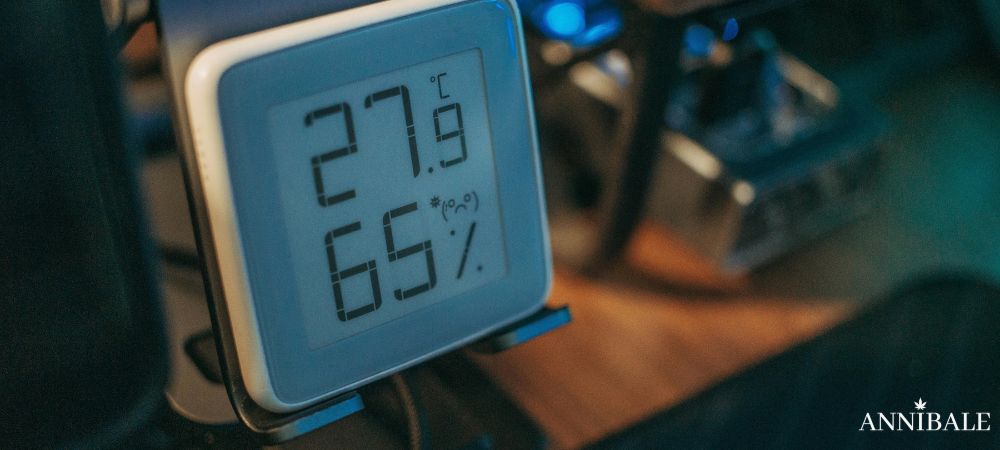
Because yes, you can have 45% RH on your thermohygrometer, a perfect VPD, a indoor dehumidifier that buzzes and purrs like a happy cat… but if the air isn’t moving well inside your grow space, you’re easily at 80-90% relative humidity inside those buds.
And that’s where botrytis starts to write its own story.
The truth about airflow that many don’t want to hear
Mold in cannabis plants doesn’t grow because “the humidity is high.”
It arises because:
- Air stagnates locally
- Transpiration from the leaves saturates the space between the buds
- Microscopic condensation remains trapped in the buds
What you measure outside… is not what happens inside the flowers.
This discrepancy between ambient RH and interstitial RH in the buds is also documented in advanced indoor horticulture (Microclimate humidity inside dense inflorescences – ResearchGate)
What a “microclimate” really is in indoor cannabis cultivation
When a plant flowers:
- It constantly transpires water
- It emits vapor from the leaf surface
- It creates a bubble of more humid air around itself
If that air is not renewed:
- Local relative humidity rises
- The temperature in the growing space increases
- Oxygen levels drop rapidly
- Mushrooms aren’t partying, they’re raving!
This process occurs especially with compact, hyper-resinous and best modern genetics such as:
That is, it occurs with all those high-yielding genetics that develop:
- compact buds
- close and tight internodes
- classic structure that gives it a “golf ball” bag appeal.
Why an exhaust fan is NOT enough to eliminate excess humidity
There’s another big myth to dispel, one we often hear from our customers:
“I have a powerful exhaust fan, with more suction than my grow space requires, so I’m good to go.”
Uh… No, that’s not the case. Using an exhaust fan alone:
- renews the air in your indoor grow room/tent
- does not guarantee air movement inside your marijuana buds during flowering stage.
If air passes over your grow, but doesn’t pass through it, you’ve simply created a miniature tropical swamp inside your grow room.
Correct Airflow: What Should Happen Physically
A properly installed airflow system in an indoor weed grow serves four main functions:
- It breaks the layer of humid air around the leaves and buds
- It lowers the relative humidity between cannabis buds in end of flowering
- It cools the buds and allows excess water to be eliminated
- It increases gas exchange.
In practice, a well-designed airflow system simulates a constant, light breeze, which only outdoor grows in tropical locations suitable for spontaneous cannabis growth can provide.
But be careful: a well-designed airflow system isn’t a hurricane, nor is it just still air, but a constant, light breeze.
How Many Fans Do You Really Need (and Where to Place Them)
Let’s stop with the vague phrases like “put a fan here, a couple more here and there.”
Minimum serious setup (80×80/100×100 tent)
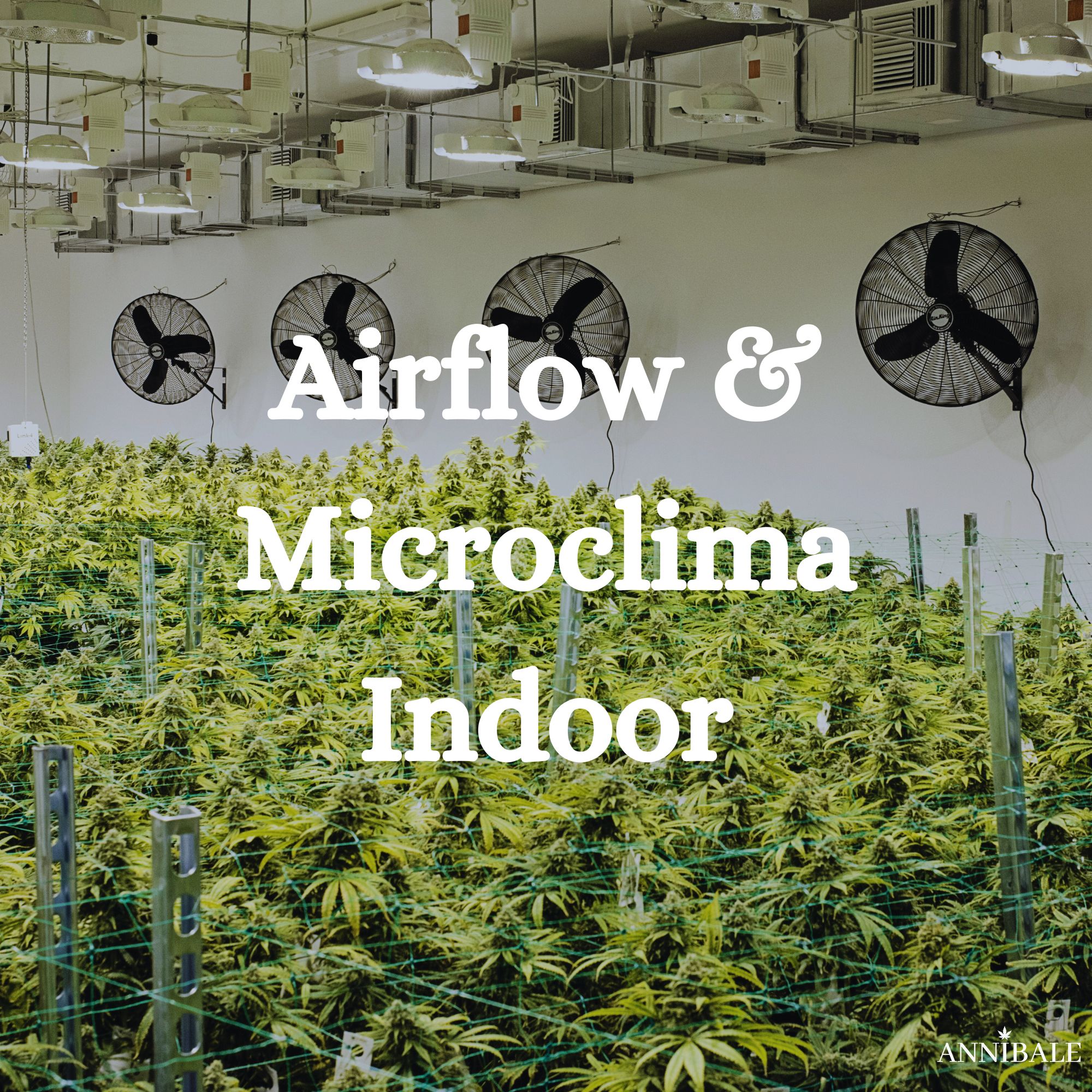
- 1 oscillating fan at the top of the grow space
- 1 fixed fan at the top, near the previous oscillating fan
- 1 properly sized (or more powerful, as recommended) extractor at the top
- 1 well-positioned and oversized active inlet at the bottom
- 1 oscillating fan at the bottom of the undergrowth.
Optimal setup (advanced flowering)
- 1 oscillating fan at the front
- 1 oscillating fan at the side
- 1 oscillating fan at the bottom
- Cross-flow airflow (active/passive extractors)
- 1 oscillating fan at the top
The golden rule: leaves must move, not thrash.
If the leaves of the cannabis plants in your grow:
- move slowly
- sway gently
- switch slightly
then yes, this is the correct way to achieve perfect airflow. But if the leaves:
- bang each other vigorously
- bend persistently in the same direction
- show dry, flaccid, or cut edges
- curl up
you are actually stressing the plants, triggering the cannabis plant’s defense mechanisms. In fact, this constant mechanical stress:
- reduces and slows growth
- lowers final flower production
- destroys terpenes, which are extremely volatile elements.
Airflow in the undergrowth: the life-saving technique that no one knows about
This is one of the gems from true growers who have accumulated experience with mold over many years of growing marijuana.
Although few people know it, botrytis often grows:
- in the lower part of the plant
- between the inner branches of the inflorescences
- where air never reaches, and humidity remains trapped with tiny water particles.
A small fan that moves the lower part of the crop:
- dries the moisture rising from the substrate with the heat of the lamps
- eliminates waterlogged soil
- drastically reduces early mold.
On forums for cannabis enthusiasts and experts like ICMag and THC Farmer, this solution constantly appears in anti-botrytis grow logs.
(ICMag Forum – airflow under canopy, botrytis prevention)
The real link between airflow and VPD
Here we enter the section for geeks who are useful to the cause. The VPD you calculate is only valid if the air is renewed around the leaf structure. In fact, if the air stagnates:
- The local humidity in the lower part of the crop rises
- The actual VPD drops
- The hemp plant transpires poorly
- The plant’s external vegetal tissues remain moist.
So remember: correct airflow = VPD that really works.
The most dangerous time: nighttime, when the lights are off
Whether it’s natural outdoors or recreated in indoor grows, at night:
- the outside temperature drops and cools
- the relative humidity increases and forms dew
- transpiration occurs continuously
- microscopic condensation forms inside the buds.
As a result, if the grow airflow drops at night, mold is guaranteed!
A common mistake we hear from our customers is:
“I turn off the fans at night to make less noise and sleep (or avoid arousing suspicion from the neighbors).”
In these cases, we usually respond literally: yes, it’s the best way to nourish mold and fungi.
Modern genetics = more aggressive airflow
This is another point that’s rarely discussed, but one that can’t be ignored in 2026.
Compared to the 1990s, the best dessert genetics:
- create denser buds
- produce greater quantities of trichomes and resin
- having a denser flower structure, allow less air to pass through.
Therefore, when dealing with these genetics, you need to adopt:
- a more constant and slightly more powerful airflow
- Lower relative humidity (RH) inside the grow room during the flowering phase week by week
- More intense, structured, and intelligent defoliation to allow greater airflow and transpiration.
With an 1980s Skunk, you could afford to make mistakes. Less so with a 2000s Amnesia; but with a Gelato 33 of today, you can no longer afford these errors.
5 Classic Airflow Mistakes We See Every Day
- Fans all pointing in the same direction → Useless airflow.
- No fans in the undergrowth → Mold that grows and proliferates from below.
- Fans too close to plants and leaves → Mechanical stress, slowed growth.
- Fans turned off at night → Condensation drips + Botrytis guaranteed.
- Trusting only the thermo-hygrometer that measures ambient humidity → Ignoring the microclimate.
Mini Botrytis Checklist From the Annibale Team
If you do EVERYTHING below:
- Relative humidity from the third week of flowering: 40–45%
- Airflow above and in the undergrowth of the grow area
- Fans on 24/7, aimed at the entire surface
- Light internal structural defoliation
- Extractor fan always on, slightly more powerful than the grow space requires
- Dehumidifier functioning and stable
- Grow space cleaned and disinfected with bleach after each new growing cycle
- Avoid water stagnation in saucers
→ Mold will become very rare occurrences, not the old routine.
Conclusion from the Annibale Genetics Team
Airflow in cannabis cultivation is not just an accessory, but an integral part of the indoor growing system. When done correctly, it creates the breeze typically found in outdoor grows.
It’s invisible. It affects yield. It preserves terpenes.
But above all:
- It protects dense flowering cannabis buds from the proliferation of molds like Botrytis.
- It protects the trichomes, terpenes, and active ingredients contained within.
- It saves your precious weeks of work and the money invested in growing.
Today, in 2026, with modern and ultra-compact genetics, anyone who doesn’t plan for airflow is just waiting for mold!
Davide V. CEO Geneticist