Indoor Dehumidifier: When to Need It, Power, and Common Mistakes
The Guide That Saves You from Damned Mold and Useless Paranoia
Welcome to this new chapter dedicated to indoor humidifiers on Annibale Seedshop’s blog. Today we’re talking about one of the most underrated tools… until you lose half your crop to various molds, like botrytis: the dehumidifier.
Because yes, you can have the best marijuana genetics, perfect LED lights, a VPD calculated to the millimeter… but if the humidity gets out of hand during Cannabis flowering phase, that’s it.
And do you want to know what the worst part is? Many growers buy one too late, when the damage has already been done, or they buy an undersized one and then say, “Well, that thing doesn’t seem to work…“.
Spoiler alert: it worked… but it was just too small for the jungle you had inside your grow tent!
When You Really Need an Indoor Dehumidifier
Let’s start with a simple truth, accessible to all cannabis growers, whether experienced or not: if you want to grow cannabis indoors in Europe, sooner or later you’ll need one.
It’s almost always necessary if:
- you grow in a cellar, garage, basement, or humid areas with little air circulation
- you live in humid areas (Northern Italy, on the coast, or especially in the Po Valley, where humidity accumulates in banks)
- you grow indoors in the summer, when irrigation evaporates faster due to the heat of the sun’s rays
- you have closed grow tents or grow rooms with a lot of biomass (plants and foliage)
- you push PPFD high during flowering (more transpiration = more vapor)
During the vegetative stage, you can also get by with an extractor fan and ventilation; in the advanced flowering stage, however, a dehumidifier stops being an optional extra and becomes an insurance policy for your entire harvest.
Cannabis dehumidifier mistake #1: Thinking that “an extractor fan is more than enough.”
- No, unfortunately, that’s not the case. In fact, an extractor fan:
- Yes, it removes humid air from the grow space… but if the incoming air it replaces is already humid… you’re just circulating highly humid air in and out of the grow tent.
Unlike an extractor fan, a dehumidifier:
- pulls water out of the air, effectively lowering the relative humidity in the room
stabilizes the nighttime microclimate (when indoor lights are off and humidity soars, increasing the risk of mold growth)
This is why on GrowDiaries and serious grow logs you almost always see: “end of flowering and use of the indoor dehumidifier = zero botrytis.”
How much power does a indoor dehumidifier really need?
Another common mistake of the novice grower: “I have a small 80×80 cm tent, SO I’ll get a small dehumidifier“.
Nothing could be more wrong. In fact, you shouldn’t just size it for the tent; you need to size it for the actual environment in which the tent is actually breathing.
Rules that really works
- Small grow room (up to 10–15 m²)
→ 10–12 L/day - Medium grow room (15–25 m²)
→ 16–20 L/day - Large or very humid grow room (20–35 m²)
→ 20–30 L/day
If you’re on the borderline between two sizes or unsure about which one to choose: always get the more powerful dehumidifier (at most, it will work less).
Do this, because an oversized dehumidifier:
- needs less work
- has a significantly longer lifespan
- stabilizes ambient humidity better
- makes less noise
- avoids daily checks on the health of your buds
Humidity ranges that save your crop from mold failure
Forget vague rules like “low humidity during flowering” or “yeah, all you need is a hygrometer and you’re good to go.”
Here we need clear and precise numbers that all indoor growers can agree on:
- Vegetative stage
60–80% RH
Fast growth, large leaves, happy roots. - Pre-flowering stage
55–60% RH
Smooth transition, less stress for plants. - Full flowering stage
45–55% RH
Safe zone for dense flowers, without dangers. - Late Flowering Stage (last 3–4 weeks)
40–45% RH
Here you’re building a real defense against molds like botrytis.
Mistake #2: Turning on the indoor dehumidifier only if you “feel or see high humidity”
This is one of the classics indoor cannabis growers mistakes.
In fact, those who grow indoors during the day may have:
- indoor lights on
- very hot air
- relative humidity seemingly okay.
But at night:
- indoor lights off
- very low temperature
- very high relative humidity
- condensation forming inside the cannabis buds
- mold starting to proliferate.
Therefore, a professional and properly sized dehumidifier:
- works 24/7
- with a set humidistat
- without having you chase the ranges needed for the health of your weed plants, especially during flowering weeks.
Where to Place an Indoor Dehumidifier
The correct location for a dehumidifier in an indoor marijuana grow room should be:
- near the grow tent, not directly inside
- in the ideal spot where it can draw in warm, humid air
- with enough free space behind and on the sides
- with continuous exhaust, if possible
However, very often, growers report keeping it in the wrong position, for example:
- inside the tent, close to the plants (risk of drying out too quickly near the dehumidifier)
- in a closed corner without proper air circulation
- in front of the exhaust fan (this way they steal air from each other)
Dehumidifier + airflow = anti-mold combo
As widely stated, a dehumidifier alone is not enough.
If the air is still inside the buds:
- Moisture remains trapped inside the plant tissues.
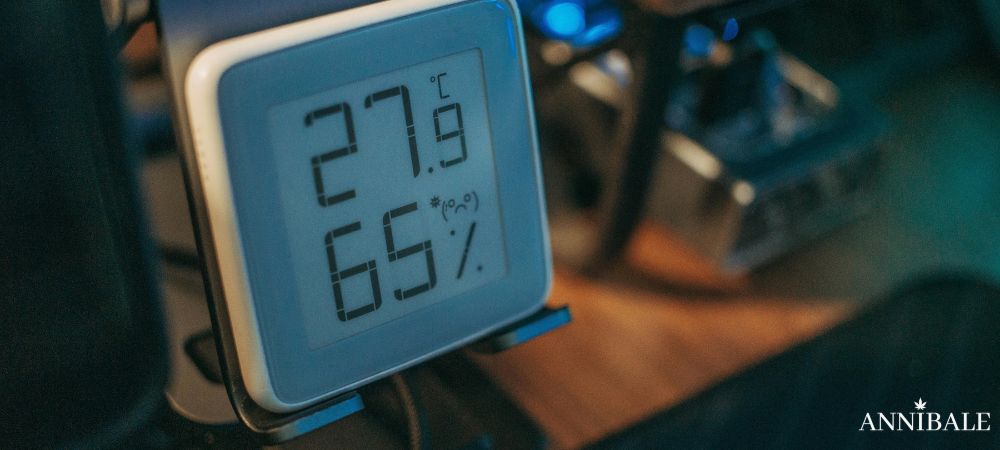
- A thermohygrometer or other sensor may read 45% relative humidity.
- But inside the hemp flower, the relative humidity is over 80%.
And it is there, at that exact moment, that botrytis grows and proliferates. Therefore, you’ll need:
- Oscillating fans on the plant canopy
- Airflow in the undergrowth area, the low area under the leaves
- No “hot air pockets”
(Microclimate in flowers and mold risk: ICMag forum, discussions on airflow and botrytis)
The 5 mistakes we see most often (and that cost indoor growers dearly)
- Dehumidifier too small → never really lowers the necessary relative humidity
- Dehumidifier only turned on during the day → nocturnal mold is guaranteed
- Relative humidity too low, too early → stressed plants, terpenes flying away
- No internal airflow → microclimate that kills marijuana buds
- Full tank and machine off → humidity rises while you sleep (classic sleepyhead grower trauma)
The truth from a professional breeder and grower
If you grow modern dessert strains or potent cannabis genetics, for example:
and therefore produce heavy buds, with large, compact flowers… without a properly set dehumidifier, you’re literally playing marijuana Russian roulette.
In conclusion…
An indoor dehumidifier in cannabis cultivation certainly doesn’t increase yields. Simply, it saves them.
In fact, an indoor dehumidifier is one of those things that:
- you don’t notice when it’s working
- but you hate when it’s missing
If you want to learn how to grow cannabis indoors in 2026 or are already ready to do so:
- buy an indoor dehumidifier that’s powerful enough for your growing space
- use it 24/7, not just when you feel the need (waiting until then could be too late)
- combine it with good airflow and VPD
- keep the relative humidity within the correct range we’ve indicated
and you’ll see the following disappear in the blink of an eye:
- mold
- paranoia
- wasted crops
And this article on the Indoor Dehumidifier ends here. We hope it’s been helpful in your growing setup. See you in the next article!
Best regards from the Annibale Seedshop Team!
Davide V, CEO, Founder & Geneticist