Complete Guide to Autoflower Cannabis Grow: Genetics, Techniques, and Yield
Welcome everyone to this new manual on our blog dedicated to cultivating Autoflowering Cannabis seeds! After analyzing closely the top 10 cannabis terpenes and their aromatic impact, fasten your seatbelts for this new technical guide brought to you by the Annibale Seedshop staff!

The Evolution of Automatics: What Is Ruderalis?
Autoflowering seeds have revolutionized the modern cannabis market. This genetic lineage is born from crossing classic photoperiod strains (Indica and Sativa) with Cannabis Ruderalis, a subspecies native to the cold regions of Eastern Europe and Siberia.
To survive short summers and harsh climates, Ruderalis developed an extraordinary evolutionary adaptation: it does not flower based on changes in light hours (photoperiod), but automatically shifts into flowering as soon as it reaches a certain biological maturity (usually between 2 and 4 weeks from germination).
To clearly understand how workflows change, here is a comparative overview of the two cultivation systems.
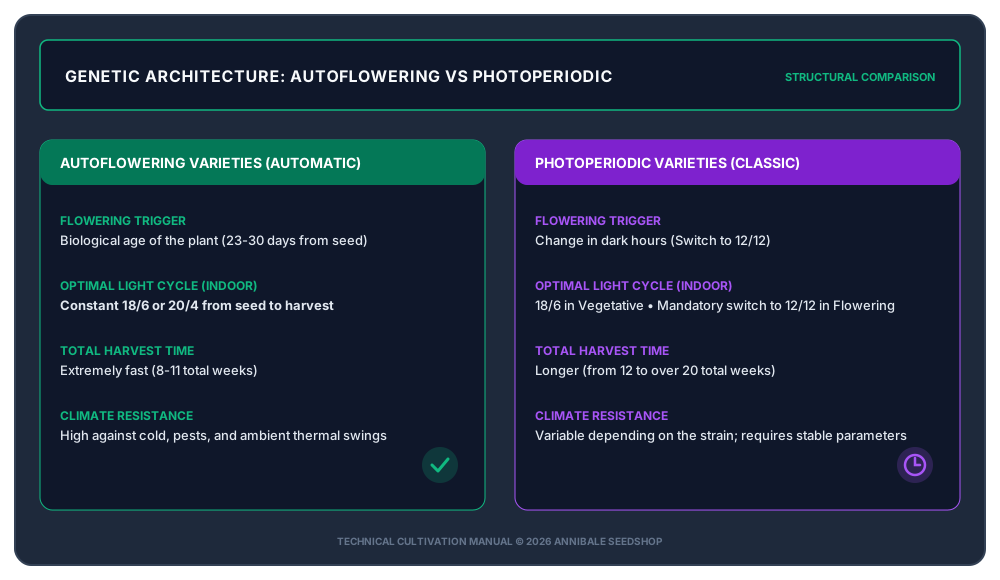
Comparative Analysis of Cultivation Environments
Automatic plants show different responses depending on the chosen cultivation setup:
- Indoor (Closed Environment): Offers absolute control over parameters. By exploiting long and constant light cycles, the plant’s accelerated metabolism is pushed to its maximum, yielding compact buds rich in resin.
- Outdoor (Open Field): Harnesses the unparalleled power of the solar spectrum. Thanks to their rapid maturation speed, autoflowers allow for multiple harvests within the same summer season, completing the cycle before the arrival of autumn rains and cold weather.
- Greenhouse: Represents the perfect balance. It combines the economic efficiency and penetration of natural sunlight with the physical protection of the structure, isolating the cultivation from sudden rain and excessive humidity.
The Cultivator’s Decalogue: 10 Rules to Optimize Automatics
The shortened life cycle of automatic plants leaves no room for error: if a plant suffers heavy stress during its first days, it won’t have time to recover its size before flowering begins. Follow these 10 key steps carefully.

1. Rigorous Genetic Selection
The quality of the harvest starts with the seed’s DNA. Choose stability, structured terpene profiles, and guaranteed germination rates from renowned breeders. Always evaluate your available space before proceeding.
2. Substrate Structure and Drainage
Autoflower roots love loose, highly oxygenated environments. Create or use a light substrate (light-mix) enriched with 20-30% perlite. This promotes the rapid root expansion necessary in the first 20 days.
3. Controlled Germination Technique
Use the damp cotton pad or paper towel method, keeping them in the dark at a constant temperature of 22-24°C. Prevent the medium from drying out completely.
4. The Final Pot (Zero Transplants)
Fundamental Rule: Autoflowers must NOT be transplanted. Every transplant causes a growth stunt of 2-4 days, which, on a vegetative cycle of just 25 days, irreversibly compromises the final size of the plant. Plant the seed directly in its final container (11 to 15 liters recommended).
5. Radical Photoperiod Management
Let’s debunk a major grow room myth: autoflowers shouldn’t be switched to 12 hours of light during flowering. Set your timer to 18 hours of light and 6 hours of darkness, or 20 hours of light and 4 hours of darkness, and maintain this exact same cycle from day one until harvest. The more light they receive, the more the flowers swell in volume.
6. Integrated Climate Targets
During the initial vegetative phase, keep temperatures stable between 21-25°C with a high relative humidity (60-70%). As the flowering phase advances, progressively lower the humidity to 40-45% to protect the internal structure of the buds from the risk of rot.
7. Moderate Nutrition and pH Control
The root system of automatic strains is more sensitive than that of their photoperiod sisters. Begin fertilizing at half the standard dosage recommended by manufacturers. Maintain the irrigation water pH between 6.0 and 6.5 when growing in soil to ensure proper assimilation of macro and microelements.
8. Training Techniques: Low Stress Training (LST) Only
Avoid aggressive pruning techniques like Topping or Fimming, which would stunt the development of the main stem. Instead, LST (Low Stress Training) is highly recommended: by gently bending the main stalk parallel to the ground using ties, you will distribute auxin evenly, allowing the side branches to receive direct light and develop into large, uniform colas.
9. Pest Prophylaxis and Monitoring
Inspect the underside of leaves and nodes daily. Intervene preventively with stable organic extracts (such as Neem oil or potassium soap) only during the vegetative phase. Avoid spraying any product directly on maturing flowers.
10. Mechanical Harvest and Deep Curing
Do not rush. Use a pocket microscope to analyze the state of the trichomes on the buds: harvest only when almost all trichomes have shifted from clear to opaque/cloudy, with a solid 10-20% showing an amber color. Conduct a slow, upside-down hang dry (15 days at 18°C and 55% RH) before sealing the flowers in glass jars for the buds curing stage.
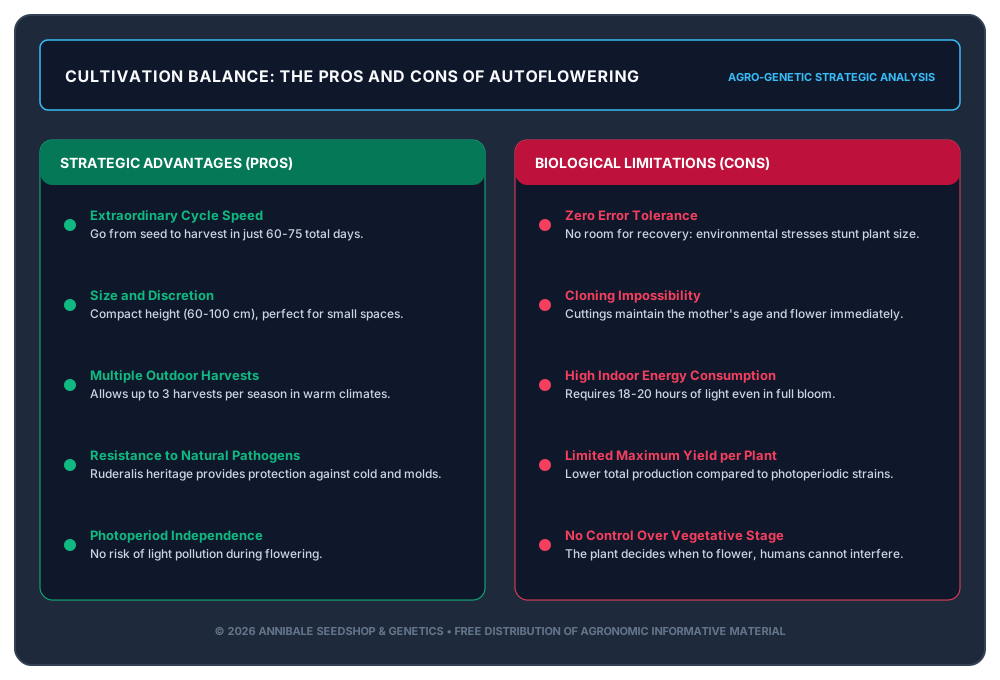
Yield Prospects: Metrics and Agricultural Performance
The yields of autoflowering plants vary based on lighting efficiency, cultivator experience, and substrate volume. Tracking current production standards, average reference values settle at the following levels:
- Indoor Yield (per Square Meter): In an optimized indoor setup (latest-generation LED lights and advanced climate control), automatic strains produce an average of 300 to 500 grams per square meter (g/m²).
- Large-Scale Yield (per Hectare): In open fields and authorized industrial agricultural contexts, total yields vary from 500 to 1000 kilograms per hectare (kg/ha) of clean and selected biomass, heavily conditioned by seeding density and seasonal weather patterns.

The 5 Most Famous Autoflowering Cannabis Strains
Let’s now examine the five most famous autoflowering cannabis strains, featuring a brief overview of cultivation info, CBD-to-THC ratio, taste and aroma, as well as effects.
Northern Lights Automatic
- Cultivation Info: Flowering time of about 9-10 weeks, height between 80 and 120 cm.
- CBD and THC Ratio: THC level of 8-14%, low CBD content.
- Taste and Aroma: Sweet and earthy aroma with notes of citrus and spices.
- Effects: Relaxing, euphoric, and happy effects.
White Widow Automatic
- Cultivation Info: Flowering time of about 10-12 weeks, height between 50 and 100 cm.
- CBD and THC Ratio: THC level of 11-14%, low CBD content.
- Taste and Aroma: Pungent and earthy flavor with notes of citrus and spices.
- Effects: Relaxing, happy, and creative effects.

Amnesia Haze Automatic
- Cultivation Info: Flowering time of about 10-12 weeks, height between 80 and 100 cm.
- CBD and THC Ratio: THC level of 15-18%, low CBD content.
- Taste and Aroma: Sweet and citrusy flavor with notes of lemon and spices.
- Effects: Euphoric, energizing, and creative effects.
Blueberry Automatic
- Cultivation Info: Flowering time of about 8-10 weeks, height between 75 and 150 cm.
- CBD and THC Ratio: THC level of 14-18%, low CBD content.
- Taste and Aroma: Sweet berry flavor with notes of blueberry and vanilla.
- Effects: Relaxing, happy, and calming effects.
AK-47 Automatic
- Cultivation Info: Flowering time of about 9-11 weeks, height between 80 and 100 cm.
- CBD and THC Ratio: THC level of 14-18%, low CBD content.
- Taste and Aroma: Spicy and earthy flavor with notes of citrus and wood.
- Effects: Euphoric, creative, and energizing effects.
10 FAQs on Growing Autoflowering Cannabis
Can I take cuttings and clone an autoflowering plant?
No. From a biological standpoint, this is strongly discouraged. Cuttings (clones) inherit the exact genetic age of the mother plant. Consequently, if you take a branch from a 20-day-old autoflower, the cutting will root and immediately shift into flowering within a week, remaining a miniature plant of just a few centimeters with zero real production.
What is the ideal light schedule (photoperiod) for indoors?
Automatic plants maximize their photosynthesis under extended light cycles. The optimal standard setup involves 18 hours of light and 6 hours of darkness constantly throughout the plant’s entire life. Many commercial growers push the cycle to 20 hours of light and 4 hours of darkness to increase the Daily Light Integral (DLI) and, as a result, the final weight of the buds.
When should I start applying flowering fertilizers?
As soon as you notice the appearance of the first pre-flowers (the white hairs or pistils at the nodes), the plant is still undergoing its vegetative “stretch” and needs nitrogen. Specific flowering nutrients (rich in phosphorus and potassium) should be introduced roughly 7-10 days after the first hairs appear, which is when the first true spherical flower clusters begin to form.
What happens if I perform a transplant anyway?
If you transplant, the root system inevitably suffers a mechanical micro-shock that halts the plant’s growth for a period ranging from 2 to 5 days. Since the vegetative phase of an autoflower lasts only about 25 days total, losing 4 days means reducing the plant’s final size by 20-30%. Always use the final container.
Why did my autoflowering plant stay only 15 centimeters tall?
Stunting in autoflowers is almost always caused by human error during the first 3 weeks of life. The main causes include overwatering (which suffocates the roots), using a substrate that is too hot/heavily pre-fertilized (which burns the root capillaries), excessively cold temperatures, or transplant shock.
Can I grow autoflowers on my home balcony?
Absolutely, yes. Thanks to their compact stature and lack of sensitivity to light pollution (nighttime streetlights won’t disrupt their flowering), they are perfect plants for discreet balconies and terraces. Just make sure they receive at least 5-6 hours of direct sunlight per day to develop dense buds.
Are autoflowering strains less potent than photoperiod ones?
Historically, the first generations of autoflowers (in the 2000s) had very low THC levels due to the strong dominance of Ruderalis. Today, thanks to intense selection and backcrossing work carried out by seed banks like Annibale Seedshop, modern “Super-Autos” easily reach 22-26% THC, matching classic photoperiod clones in terms of both potency and terpene profile.
Is it possible to apply the ScROG (Screen of Green) technique?
Classic ScROG requires long training periods and heavy pruning that do not adapt well to the tight timelines of automatics. However, you can place a support screen to guide lower branches outward via light LST, but the netting density must be managed quickly before the plant structure hardens with the onset of flowering.
How long does the total life cycle actually last?
While seed banks often state ideal laboratory timelines (e.g., 60 days), in real agronomic settings, most autoflowers take between 70 and 85 days from seed to harvest. Environmental factors, sub-optimal temperatures, or mild physiological stress can extend the trichome maturation phase by a few days.
When should I flush the roots before harvest?
Rinsing the substrate with plain water should begin roughly 10-14 days before the expected harvest. The exact moment is identified by monitoring the trichomes under a microscope: when nearly all resin heads shift from clear to fully milky (cloudy), stop using fertilizers to force the plant to consume its stored nutrient reserves in the leaves, drastically improving the purity and smoothness of the smoke.
Conclusions…
Autoflowering cannabis seeds have become extremely popular among growers due to their ease of cultivation, speed of growth, and fast yields. The main differences between autoflowering and photoperiod seeds involve the life cycle, yield, and lighting flexibility.
With solid planning and proper care, it is entirely possible to achieve abundant, high-quality harvests. The mentioned autoflowering strains offer a wide range of flavor profiles, effects, and cannabinoid levels. Choose the one that best suits your preferences and enjoy the journey of cultivating autoflowering cannabis.
And that wraps up this guide on How to Grow Autoflowering Cannabis. Hoping this has been helpful, we’ll see you in the next article!
Best regards from the Annibale Seedshop Team!
Davide V, CEO, Founder & Geneticist