Fimming Technique in Cannabis Cultivation: Maximizing Main Branches
Welcome everyone to this new chapter of our “Cannabis Cultivation Manual,” brought to you by the Annibale Seedshop team. Today, we will focus on one of the most discussed, loved, and misunderstood hormonal manipulation techniques on the international stage: the Fimming (FIM) technique.
As we mentioned in the last chapter dedicated to Topping, Fimming stands as an advanced methodology to maximize the final yield of the plant. Although the basic biological principles are similar to those of classic apical pruning, the true dividing line lies in the geometry of the cut, the number of structural branches generated, and the level of precision required during execution.
What Is the Fimming Technique?
Fimming, or more commonly FIM, is a partial pruning technique applied to cannabis during the vegetative phase. The name itself reveals its bizarre and exceptional nature: “FIM” is the acronym for the English phrase “Fuck, I Missed!” (“Damn, I missed my mark!”), an exclamation of frustration uttered by the American grower who discovered it by mistake.
While attempting to perform a conventional Topping by removing the entire apex, his imprecision led him to cut off only a part of the bud. At that moment, he couldn’t imagine that, thanks to that millimeter calculation error, he would open the doors to one of the most efficient High Stress Training (HST) techniques in history.
Topping vs. Fimming: The Yield Multiplier
What clearly distinguishes the two techniques is the structural multiplication factor:
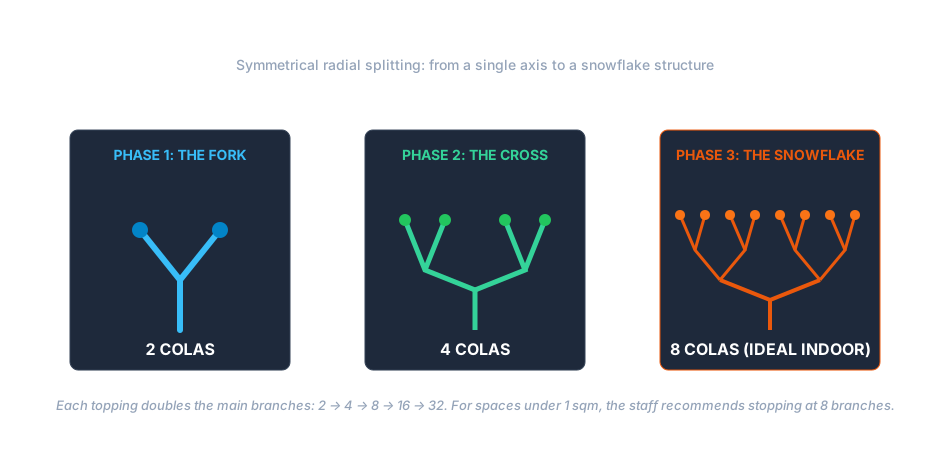
- With classic Topping: Completely removing the apex results in the mathematical division of the stem into two main branches.
- With Fimming: Thanks to the fact that the oblique cut simultaneously intersects multiple micro-internodes in the process of forming, it is possible to develop anywhere from four to more than eight primary structural branches with a single intervention.
Note from the Annibale Lab: During our genetic tests, the best documented result was obtaining no fewer than 10 new dominant apical branches from a single application of the FIM technique on an ultra-vigorous Skunk #1 phenotype from Sensi Seeds.
Along with Topping, controlled bending (LST – Low Stress Training), and Mainlining, Fimming represents the ideal backbone for anyone wanting to set up a grow room based on the SCROG (Screen Of Green) method, optimizing net filling times.
Why Use the Fimming Technique in Cannabis Cultivation?
A question naturally arises: why should a grower prefer a complex, geometrically unstable technique that requires millimeter precision over the proven Topping method? The strategic advantages are evident and can be summarized in two crucial points:
1. Safety Parachute (Zero Risk)
The biological beauty of Fimming lies in its “worst-case scenario.” If you miss the angle or depth of the cut by removing too much tissue, you have simply performed a classic Topping. You will still get two dominant buds without losing anything at all in terms of plant health.
2. Savings on Vegetative Time
Fimming requires a few more days than Topping to show a vegetative restart (usually 5 to 7 days of stasis), as the wound is jagged and affects multiple leaf layers. However, correct application is equivalent to performing two Topping sessions at once. This allows you to save about 3-4 weeks of waiting time (the biological time it would take to let the plant grow, perform a first Topping, wait for the development of the two branches, and prune them again).

How to Apply Fimming in Cannabis Cultivation: A Practical Guide
Unlike Topping, which can be carried out as soon as the seedling is stable, Fimming requires a solid physical structure and a vigorous lymphatic push.
Starting Requirements:
- Structural Maturity: Wait until the plant is large enough to have developed and consolidated at least 6 – 10 sets of leaves (the ideal time to intervene is upon reaching the eighth internode).
- Genetic Vigor: Choose this technique only on genetic lines known for their strong vegetative dominance. A thick and turgid apex is infinitely easier to treat than a slender stem.
Execution Technique (The 45° Cut):
- Instrumental Approach: Although the inventor discovered the technique by pinching the apex with their fingernails (a method that remains highly valid if hands are obsessively sterilized), we recommend using precision trimming scissors previously disinfected with isopropyl alcohol.
- The Apex Grip: Gently grasp the last clump of emerging leaves on the tip of the plant, holding it tightly between your fingers.
- The Partial Clean Cut: Do not cut at the base of the node. You need to remove about 80% of the bud’s vegetative mass, making an inclined cut at a 45° angle. The lower portion (the remaining 20%) must remain intact on the stem: it is in that small cup of severed tissue where the micro-internodes reside that will give life to the multi-forking.
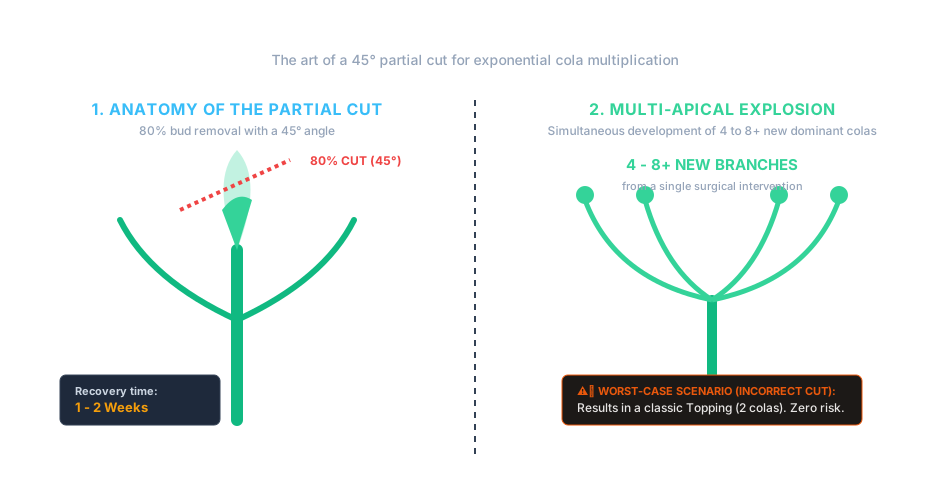
After the operation, the plant will initially look damaged, and the first tiny leaves emerging from the wound will appear cut in half or asymmetrical. This is completely normal: do not touch them. The real results will not be visible for at least 1-2 weeks. If after this time you notice only two symmetrical buds, it means you removed too much tissue; you can try the FIM technique again on the new branches as soon as the plant has regained its full vigor.
ABSOLUTE IMPERATIVE RULE: NEVER apply the Fimming technique during the flowering stage.
Tips from the Annibale Seedshop Staff
Fimming is a technique that blends perfectly with the philosophy of the “artisan grower”: theory provides the map, but only your eye and field experience will give you the mathematical certainty of the result. Here are our operational pillars:
- The Eighth Stage Is Key: Do not rush ahead of time. Intervening at the eighth leaf stage ensures that the root system is powerful enough to push sap with enough pressure to force the simultaneous birth of all new buds.
- The Risk of Flowering Lockout: If you try to perform Fimming after the hormonal light switch (12/12), you will cause a destructive metabolic shock. The plant will stop bud production, focusing its scarce energy on trying to heal a complex wound. The final result will be tiny, woody, structurally stunted plants with almost non-existent flower production.
Mastering Fimming requires patience, but once you understand the exact millimeter of the cut, managing indoor Cannabis cultivation will hold no more secrets for you.

And that’s all for today, keep following us to learn more about the “early weeks of cannabis flowering“!
Greetings from the Annibale Seedshop Team!
Davide, CEO, Founder & Geneticist