Cannabis Plant Drying Stage: How to Dry Correctly the Marijuana Buds
Welcome everyone to this new, essential chapter of our cultivation guide by Annibale Seedshop. Today, we will delve into what is, for all intents and purposes, a magical and delicate art: cannabis drying!
In the previous chapter, we analyzed the evolution of the flowering stage week by week in detail. If you have also grasped the concepts of when to harvest cannabis, you are finally ready to take the next step. We will learn how to manage environmental parameters and treat the buds to preserve the maximum therapeutic, psychoactive, and organoleptic potential of your harvest intact, transforming simple flowers into a product worthy of the best Dutch coffeeshops!

When and How to Harvest Cannabis: The Final Act
Before you can hang and dry your buds, you inevitably have to go through the best moment for cutting Marijauna plant. As we have already mentioned, timing in this phase is crucial and determines the chemical balance of the resin:
- Early Harvest: This is the typical mistake of novice growers, but it is also frequently practiced by those growing Outdoors or in Guerrilla setups to anticipate the arrival of bad autumn weather and prevent rain and humidity from destroying months of work. It is also implemented by commercial growers to accelerate profit cycles, resulting however in poor, low-potency, and poorly kept harvests. Cutting ahead of time means having buds poor in essential oils and with predominantly energetic but incomplete effects.
- Late Harvest: Delaying the harvest beyond the optimal window (when more than 50% of the trichomes are completely oxidized) leads to a marginal increase in flower weight, but degrades THC into CBN. The final effect will be heavily narcotic, sedative, and poorly psychedelic. Those aiming for hashish production, however, may decide to delay the cut precisely to maximize overall resin secretion.
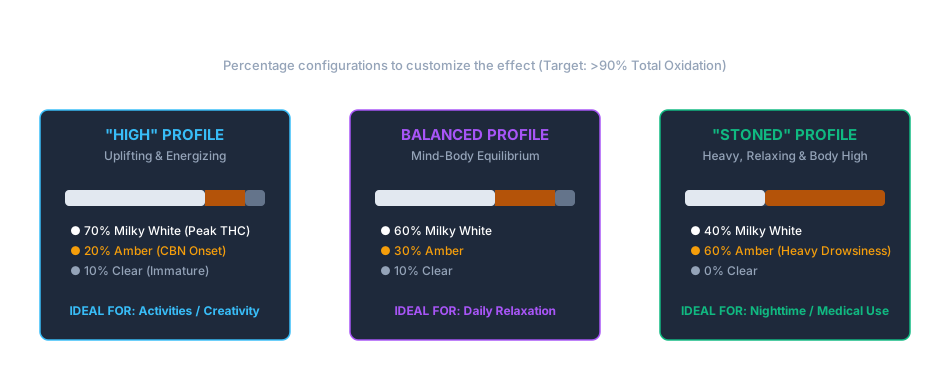
The ideal time to cut the plants is when more than 90% of the trichomes are oxidized (without the absolute distinction between milky or amber color constituting a dogmatic limit). You can use these indicative percentages as guidelines to customize the effects according to your tastes:
- “High” Effect (Cerebral/Active): 70% milky trichomes, 20% amber, 10% clear.
- Balanced Effect: 60% milky trichomes, 30% amber, 10% clear.
- “Stoned” Effect (Body/Narcotic): 40% milky trichomes, 60% amber.

How to Dry Marijuana: The Scientific Method
Drying is not just waiting, but a controlled biochemical process. Drying weed incorrectly or too quickly destroys the aromas (terpenes) and flavors (flavonoids), and risks generating harsh smoke that is harmful to health during combustion.
The golden rule is a slow drying process with controlled environmental parameters. In the dedicated drying room, relative humidity must never exceed 70% and the temperature must strictly remain below a maximum of 24°C.
The Annibale Team recommends breaking down the drying process into two distinct phases to eliminate risks and optimize the purity of the flowers:

Phase 1: Initial Moisture Reduction (Duration: 3-6 days)
In this first part, the buds are loaded with water and sap. The risk of fungal attacks is at its peak.
- Relative Humidity (RH): Maintain a low level, between 40% and 50%.
- Temperature: Set a stable 20°C – 22°C.
- Goal: Dry the surface layer, drastically reducing the risk of mold. This phase ends when the outermost small leaves start to feel “crispy” to the touch.
Phase 2: Slow Drying and Aroma Fixing
Once surface excess water is removed, the process must be slowed down to allow internal liquids to sweat out evenly.
- Relative Humidity (RH): Raise values between 55% and 65%.
- Temperature: Lower the environment to 16°C – 18°C.
- Ventilation: Use a clip-on fan positioned far away and never aimed directly at the plants. Its sole purpose is to move stale air to avoid pockets of stagnant humidity, without forcefully drying out the flowers.
- The branch test: The entire process can take anywhere from 6 to 18 total days (up to 21 days with whole-plant methods). The flowers are ready for curing when the main branch supporting them snaps with a clean “crack,” without bending or showing elastic resistance.

Cannabis Trimming: Pre-Drying vs. Post-Drying
Trimming (or manicuring) consists of removing excess leaves surrounding the buds. This is a mandatory step to ensure proper cleaning of medical or recreational material, unless you are growing special genetics selected for an extremely high calyx-to-leaf ratio, such as Glueberry O.G., Amnesia Haze, or Peyote Cookies.
There are two proven schools of thought:
1. Pre-Drying Trimming (Wet Trimming)
Consists of completely cleaning the flowers right after cutting the plant, while they are still fresh.
- Fan leaves and sugar leaves (the resinous little leaves close to the calyxes, excellent for producing premium quality extracts and hashish) are removed immediately.
- It is possible to separate the secondary branches from the main trunk.
- Advantages: Increases airflow between flowers inside the drying space and speeds up the process by a few days.

2. Post-Drying Trimming (Dry Trimming)
The plants are cut at the base and hung completely whole and intact on lines or drying racks, using the internodes as a natural hook. The final cleaning is postponed until drying is complete.
- Advantages: Ensures a much slower, gradual, and more homogeneous drying, preserving volatile terpenes to the maximum. The final flavor is distinctly superior.
- Disadvantages: Requires extreme care and gentleness during the subsequent cleaning, as dry trichomes are crystallized and highly fragile.

The Exclusive Annibale Seedshop Method
Over the years and cultivation cycles, our Team has developed a hybrid approach that we believe is absolutely the best for preserving the commercial and organoleptic quality of the inflorescences.
We recommend dividing trimming into two phases:
- Before cutting/drying: Remove exclusively the large fan leaves and all plant parts devoid of trichomes and resin. Leave the plant completely whole and hang it upside down.
- After drying (duration 10-21 days): When the plant is dry, proceed to carefully trim all the sugar leaves. This method slows down the drying just to the right point and makes harvesting the resinous little leaf much easier, ideal for accumulating raw material for elite hashish extractions.
Safety note: Always perform defoliation and trimming using specific, well-sharpened scissors; using dull or unsuitable blades will end up crushing the buds, breaking their trichomes and dispersing the liquid resin onto the blades.

Curing: The Final Maturation of the Flowers
The Cannabis curing phase is the last, fundamental piece for success. If drying serves to eliminate water, curing serves to mature the active ingredients and degrade the chlorophyll trapped inside the flower. Chlorophyll is responsible for that annoying “freshly cut lawn grass” taste and makes combustion difficult and irritating to the throat.
Curing transforms complex sugars and refines aromas, exactly like what happens during the ripening of a fine fruit.
The Annibale Team Curing Protocol
- Start: Start curing only when drying is complete (branch test passed). Placing still-damp buds into jars will cause the immediate development of pathogens and destructive molds (such as botrytis), rotting the harvest.
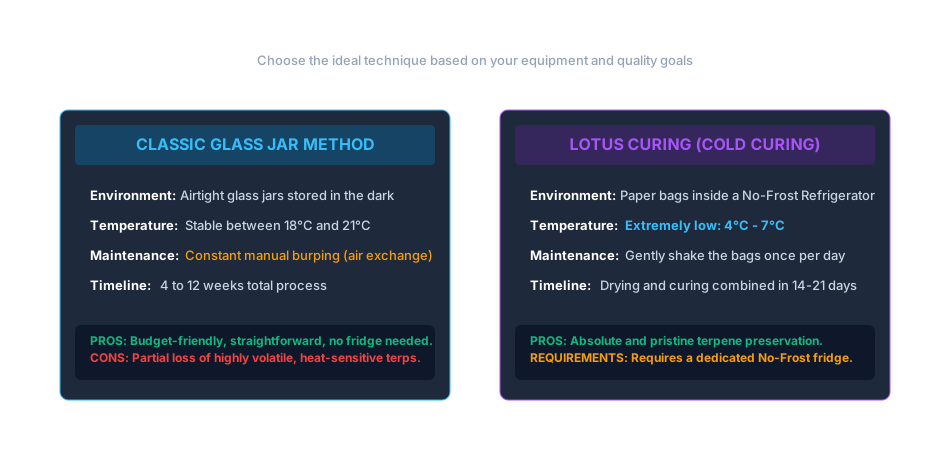
- Jarring: Place the clean flowers inside airtight glass jars or vacuum containers. Leave the jars sealed for the first 24 hours.
- The first week (Critical Phase): The deep internal moisture of the stem will move outward. You will notice that the flowers, apparently dry the day before, will feel soft and damp again. To evaporate this moisture loaded with chlorophyll, open the jars once every 8 hours for just 2 minutes, then seal tightly again with care.
- From the second week onward: Decrease the frequency of openings to once a day, and later to once every 2 or 3 days.
- Optimal maturation: After about a month and a half (45 days) of this process, the flowers will have a smooth taste, intense and distinct aromas, and stabilized sugars. The ideal relative humidity inside the jars for long-term storage must strictly settle between 58% and 63%.
The Modern Alternative: Lotus Curing (Cold Curing)
If you are looking for the absolute maximum in terms of terpene preservation, there is an advanced technique that is revolutionizing the world of professional growers: Lotus Curing, which is controlled curing in the refrigerator.
Since terpenes (the compounds responsible for scent and flavor) are highly volatile molecules that easily evaporate at temperatures above 20°C, Lotus Curing bypasses this problem by utilizing the cold to dry and cure the flowers simultaneously, preserving aromas that would otherwise be lost.
Final Team Tips and Recommendations
- Indirect Ventilation: Never point a fan directly at the hanging buds to speed up times. Terpenes are highly volatile compounds: a direct airflow will sweep them away, leaving you with dry but scentless weed.
- No shortcuts: Do not try to get ahead of schedule by jarring damp buds to be clever. You only risk throwing away months of hard work due to mold.
- Hands off: Resist the temptation to constantly touch the buds during drying and do not sample them early; you would only waste the product. Dry trichomes are as fragile as crystal: any unnecessary pressure or handling causes their immediate breakage, altering the quality of your work.
- Patience always pays off: Always remember our metaphor… isn’t a well-ripened mango infinitely better and juicier than an unripe one picked from the tree ahead of time?

And that’s all for this chapter regarding proper Cannabis drying and curing. Hoping to have helped you discover how to dry Marijuana correctly, we invite you to read our next article on “pH and EC in Marijuana Cultivation“.
Keep following us, greetings from the Annibale Seedshop Team!
Davide, CEO, Founder & Geneticist