How to Tell the Sex of Cannabis: Male, Female, or Hermaphrodite
Welcome to a new, fundamental chapter of our Cannabis Cultivation Manual. Today, we face what is considered the true turning point of any growing season, whether indoor or outdoor: identifying the sex of the plants.
Knowing how to identify a male marijuana plant from a female one with surgical precision and absolute timing is the only line of defense separating a legendary harvest of dense, resinous, seedless buds (Sinsemilla) from a biological and economic disaster. In fact, a few pollen sacs escaping the grower’s eye are enough to jeopardize months of hard work, turning floral calyxes into a factory of seeds that are useless for consumption.
In this article, we will explore pre-flower morphology, the timing of genetic expression, and the dynamics of hermaphroditism, drawing on the best practices shared across historic international communities like ICMag and THCFarmer!

Regular VS Feminized Genetics: The Grower’s Historical Compromise
In today’s market, the vast majority of commercial and home growers prefer to rely on feminized seeds or feminized autoflowering seeds (which guarantee a 99% plus probability of developing female plants). Why then do professional breeders and genetic purists continue to prefer regular seeds?
Regular seeds offer the pure, unaltered genetic lineage of a marijuana strain. Having not undergone chemical sex reversal processes (using silver thiosulfate or colloidal silver), plants grown from regular seeds display superior hybrid vigor, greater long-term structural genetic stability, and are indispensable if the goal is breeding—crossbreeding varieties to create new terpene profiles. The price to pay for this purity is statistics: about 50% of plants grown from regular seeds will be male. Hence, the absolute requirement of knowing how to recognize them before it’s too late.
The Biochemical Profile and the Dutch Coffeeshop Case Study
The main difference between the two sexes lies in evolutionary specialization and, consequently, the active ingredient content (THC, CBD, CBG).
- The female plant is programmed to attract pollen through resin secretion. Its trichomes are reservoirs packed with cannabinoids and complex terpenes.
- The male plant does not need to produce heavy inflorescences; its sole biological task is the production of volatile pollen. Consequently, it produces THC in minimal amounts, insufficient to generate any noticeable psychoactive effects.
Technical Curiosity from the Coffeeshops
In the famous Amsterdam Coffeeshop circuit and across the rest of the Netherlands, there is a ban on smoking tobacco inside the venues. To bypass this limit without forcing customers to smoke solely pure cannabis, many establishments provide a tobacco substitute (tabaksvervanger) free of charge. In most cases, this is a herbal blend based on the shredded leaves and plant parts of male hemp or industrial hemp. While it is a healthy and legal solution, consumer habits die hard, and many still prefer using traditional tobacco in their preparations.

The Transition Time Window: When Pre-Flowers Appear
During the vegetative growth phase (under a photoperiod of 18 hours of light and 6 of dark indoors, or during the months of June and July outdoors), male and female plants are visually identical. Their true genetic nature remains silent until the transition phase is triggered.
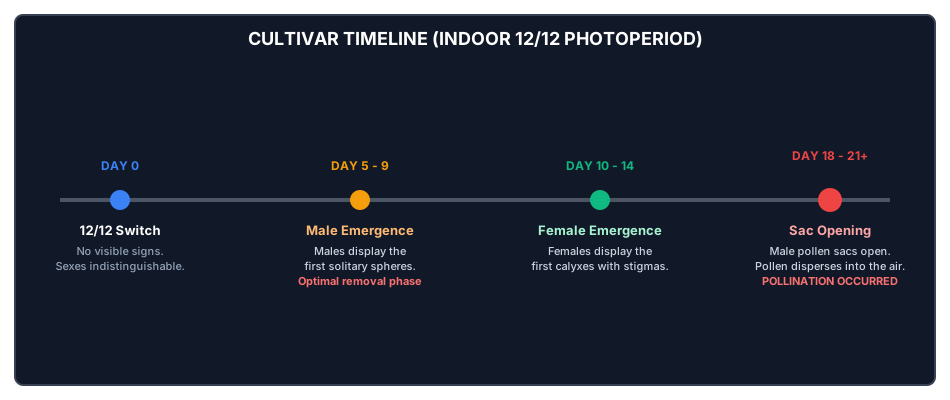
Indoors, this occurs within the first two weeks after changing the timer to 12 hours of light and 12 hours of dark. Outdoors in the northern hemisphere (Italy and Europe), the transition naturally kicks off toward the beginning of August, when the days begin to shorten significantly.
In this highly delicate initial flowering phase, the plant undergoes the so-called stretching phase (a sudden vertical elongation of the structure) and begins to develop pre-flowers (primordial flowers). These small signs initially appear in the plant’s highest nodes, specifically in the internode—the exact point where the leaf petiole and lateral branch attach to the main stem.
Morphology and Distinctive Signs of Both Sexes
Morphological Characteristics of the Female Plant
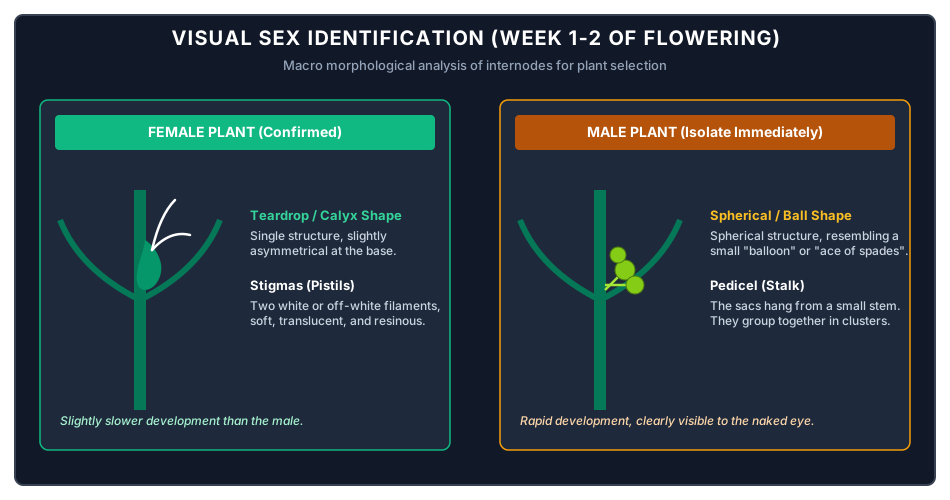
The female marijuana plant expresses its pre-flowers with a slight temporal shyness compared to the male. Structurally, it tends to maintain slightly denser internodes and emanates a more pungent herbal aroma as early as the first weeks of transition.
The unmistakable sign of its femininity is the pyriform calyx (shaped like a teardrop or an upside-down ace of spades). This small green pod is anchored directly to the internode. From this calyx, two white and translucent hairs always emerge, scientifically called stigmas (commonly known as pistils). Stigmas have a moist, sticky texture specifically designed to capture windborne pollen. If you spot these two white filaments popping out from the internode, your plant is 100% female.

Morphological Characteristics of the Male Plant
Male plants are more precocious: they start stretching before females and develop larger pre-flowers, making them very easy to spot with the naked eye or with the help of a simple jeweler’s loupe (10x/30x magnification).
Male flowers do not feature elongated calyxes or pistils. They are composed exclusively of pollen sacs: perfect small spheres supported by a tiny stem called a pedicel. As the days pass, these spheres increase in number, clustering together to resemble a small bunch of bananas or tiny melons creased with vertical lines.

The Mechanics of Pollination and the Risk of “Drift”
If the pollen sacs are not removed before the twentieth day after the photoperiod switch, they reach full maturity. The sepals making up the sphere open in a star shape, exposing stamens loaded with ultra-fine pollen.
At this point, a mere breeze in outdoor grows (or the airflow generated by fans and extractors in indoor grows) is enough to scatter millions of pollen grains. Outdoors, pollen from a vigorous male can travel for several kilometers, pollinating the crops of unsuspecting neighbors. In indoor grows, pollen instantly saturates the grow room, penetrating air filters and sticking to the grower’s clothes, creating a risk of permanent cross-contamination for future cycles.
The Labyrinth of Hermaphroditism: Genetics and Environmental Stress
In the cannabis kingdom, sex is not always a binary choice. There is a third, fearsome scenario: hermaphroditism (or intersexuality). A hermaphrodite plant possesses the genetic information to simultaneously develop both female flowers (calyxes and pistils) and male reproductive organs (pollen sacs or “nanners”).
The Causes: Unstable Bloodlines and Inbreeding Depression
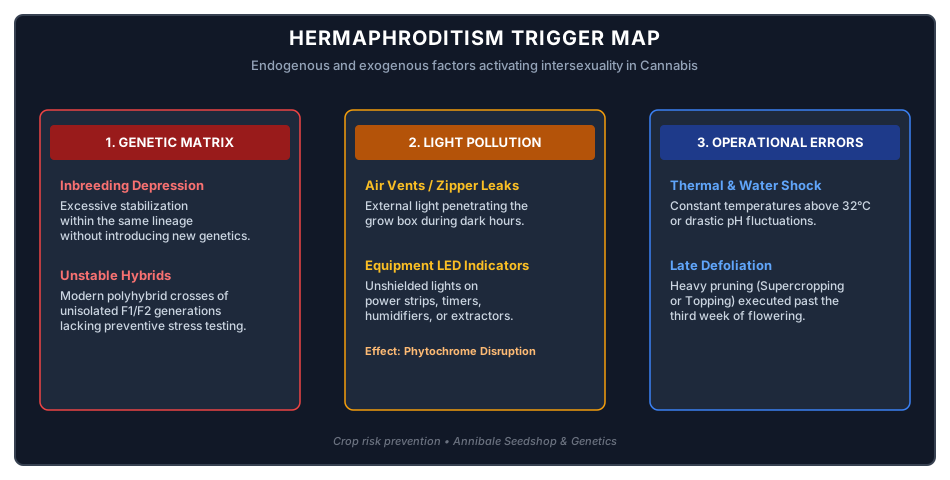
Hermaphroditism can have a purely genetic root. This frequently happens when working with poorly stabilized modern hybrids or by repeating crosses within the exact same family pool (continuous backcrossing between parents and offspring or between siblings, a dynamic known as inbreeding depression). When the genetic makeup is too uniform and lacks variability, the recessive genes associated with intersexuality tend to emerge unpredictably, manifesting in subsequent generations.

The Environmental Triggers: The Role of Light Leaks
Very often, hermaphroditism is an extreme evolutionary survival response caused by severe environmental stress. When a female plant senses that external conditions endanger its life, it activates an emergency mechanism: it produces pollen on its own to self-pollinate, ensuring the survival of the species through seed production.
According to data shared by expert growers on THCFarmer, the number one indoor environmental trigger is light leaks during the 12 hours of total darkness. Indicator lights on power strips, unshaded LEDs on dehumidifiers, or faulty grow box zippers disrupt phytochrome production (the flowering hormone), scrambling the plant’s biological clock and triggering the sudden appearance of male pre-flowers right in the middle of a female bloom.
Other critical stressors include:
- Extreme temperature swings (temperatures above 32°C or below 15°C).
- Aggressive pruning or defoliation performed during late flowering.
- Nutrient dosing errors (EC shock or messed-up pH levels).
Practical Vademecum for Daily Inspection
To minimize risks within your crop, we recommend structuring a methodical inspection routine based on commercial breeding guidelines:
- Central Node Inspection: Starting from the fifth day after the photoperiod switch (12/12), check the section of the stem between the 4th and 6th nodes. This is the anatomical zone where the vast majority of plants display their first sexual signs.
- Use of Optical Tools: Do not rely solely on the naked eye. A pocket cultivation microscope or a macro lens will allow you to distinguish the asymmetrical base of a primordial calyx from the rounded pedicel of a male sac several days in advance.
- Immediate Isolation: If you spot a male and are growing from regular seeds with the sole purpose of harvesting female flowers, do not hesitate. Turn off the grow room fans to prevent air movement, cover the male plant with a plastic bag to contain any early pollen release, and permanently remove it from the cultivation space.

FAQ: Everything You Need to Know About Male VS Female Cannabis Plants
Can I tell the sex of the plant by looking at the shape of the seed before planting it?
No. This is a total urban legend. There is no visual, microscopic, or geometric method (such as the shape of the seed’s base, color, or striping) capable of revealing whether a regular seed will produce a male or a female. The only way to know the sex is to wait for pre-flower expression, or alternatively, run a DNA test on a newborn leaf in specialized laboratories (a practice only used by large commercial breeders).
If a female plant is pollinated, can its buds still be smoked?
Yes, but quality, potency, and yield collapse drastically. When pollen touches the stigmas, the plant immediately halts the production of resin and THC to focus all metabolic energy on manufacturing seeds. You will end up with buds full of annoying seeds to roll, with a harsh, acrid taste, and a sharp reduction in psychoactive or therapeutic effects.
How much time do I have to remove a male before it becomes dangerous?
About 7 to 10 days from the appearance of the first “ball”. Male pre-flowers develop quickly, but pollen sacs need time to mature, fill with pollen, and open. If you check your grow box or garden at least twice a week, you will have plenty of time to identify the spheres and remove the plant before the sepals open in a star shape to release pollen.
If I find seeds in the buds of a definitively feminized plant, will those seeds be male or female?
They will almost certainly be feminized seeds, but at high risk of hermaphroditism. If the plant was not exposed to a male, it means it self-pollinated by producing pollen from an intersex (hermaphrodite) bud due to stress. The resulting seeds inherit only the mother’s XX chromosomes (so they will be female), but they will also inherit her exact same genetic vulnerability to stress, tending to become hermaphrodites themselves.
Can I save a hermaphrodite plant by simply plucking off the male flowers?
Yes, but only if the infestation is minimal and controlled. If toward the end of flowering you notice only two or three small “nanners” (solitary banana-shaped pollen sacs), you can gently remove them with wet tweezers (water sterilizes pollen instantly). If, on the other hand, the plant shows widespread male clusters across all branches, it is genetically unstable and must be chopped immediately to save the rest of the grow room.
Do male plants produce THC? Is it worth smoking or processing them?
THC production in males is infinitesimal and will not get you high. Although males have a tiny percentage of cannabinoids in their leaves and flowers, they do not develop the dense glandular trichomes typical of the female. Smoking them is useless and harmful to the lungs. As mentioned in the article, in Dutch coffeeshops, male plant matter is used exclusively as a clean, nicotine-free tobacco substitute, but not for recreational purposes.
If I remove a male plant from the grow box, how long does its pollen remain active in the air?
Free pollen is volatile, but fortunately, it is highly sensitive to humidity. In a dry environment, it can stay active for a few days. If you removed a male that had already started spraying pollen, the pro trick is to mist pure water onto all walls of the grow box and the remaining plants. Heavy moisture weighs the pollen down, making it drop to the floor, and destroys the vitality of the pollen grain within minutes, rendering it sterile.
Can autoflowering varieties also turn out to be male or become hermaphrodite?
Yes, exactly like photoperiod strains. If you buy regular autoflowering seeds, you have a 50% chance of finding automatic males. If you buy feminized autoflowering seeds, the male risk is eliminated, but the possibility of hermaphroditism remains if you expose the plant to severe thermal, water, or light stress during their very short life cycle.
What is a male cannabis plant good for if it doesn’t produce smokeable buds?
It is the backbone of breeding and biodiversity. Without males, seeds wouldn’t exist, and new strains couldn’t be created. The male transmits key traits to the offspring, such as pest resistance, structural robustness, flowering speed, and, in many cases, it boosts the terpene profile of the next generation’s buds. Furthermore, male plants are excellent for textile fiber extraction and soil cleanup (phytoremediation).
What are the so-called “Nanners” (Bananiti) and why are they different from normal pollen sacs?
Nanners are naked male organs that grow directly inside female buds. While a pure male plant produces external spherical pollen sacs that must split open to release pollen, a “nanner” is the internal stamen of the male flower growing by mistake inside the female calyx due to late-flowering shock. Lacking an outer shell, it begins pollinating the surrounding flower the exact moment it appears, requiring immediate surgical removal by the grower.

And that is all for this article dedicated to the difference between Male Cannabis VS Female Marijuana! Hoping that knowing the differences has been helpful, keep following us for our next article dedicated to the effects of Cannabis Indica and Sativa VS Hashish!
Greetings from the Annibale Seedshop Team!
Davide, CEO, Founder & Geneticist