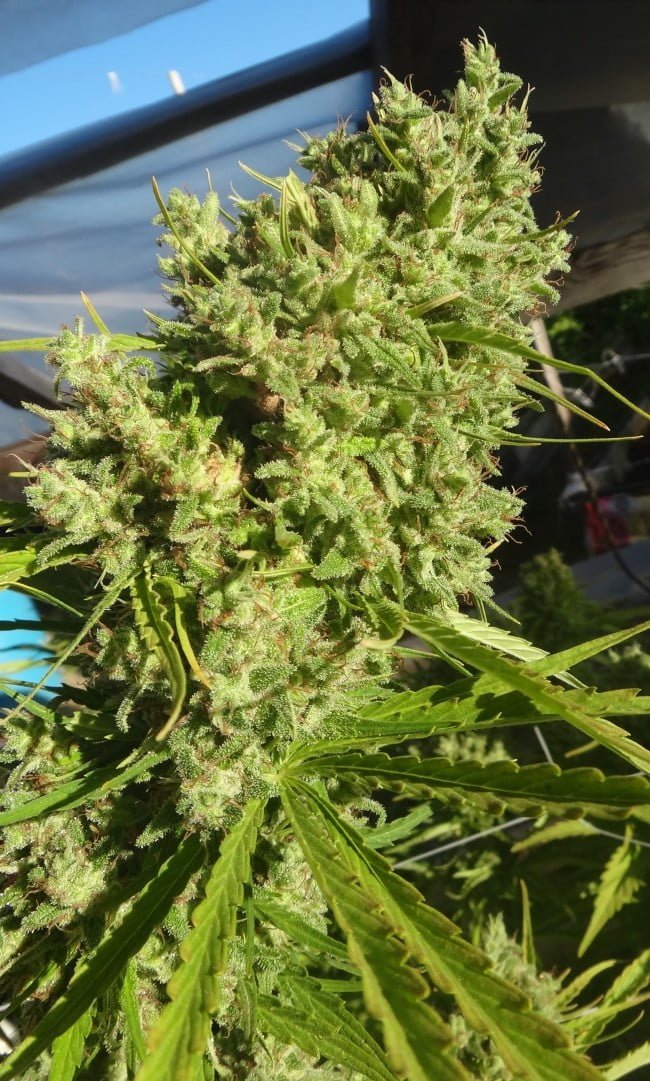
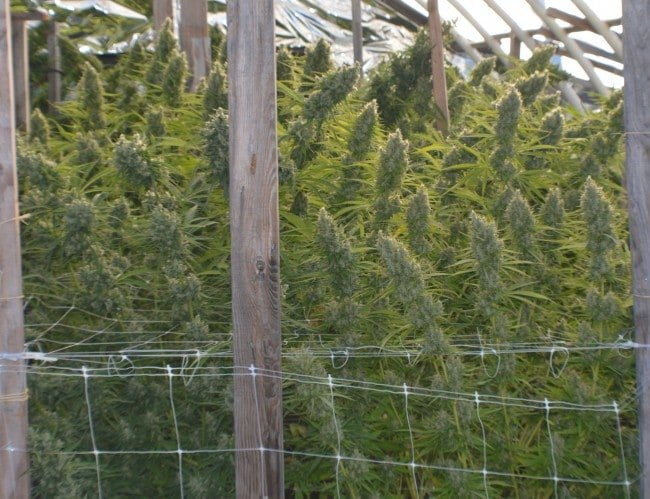
Killer A5 Haze Feminized stands at the absolute pinnacle of the most powerful and extreme sativas created by the Spanish breeder.
This cross represents a complex agronomic operation, aimed at merging the legendary A5 Haze clone by Nevil Schoenmakers (Northern Lights #5 x Haze A) with the most stable and psychotropic expression of the Malawi Killer.
Structurally, it manifests the typical dominance of high-altitude sativas, combined with resin production and bud density that exceed the standard parameters of traditional long-flowering varieties.
Killer A5 Haze Feminized in brief
Killer A5 Haze Feminized is a highly sativa-dominant hybrid (80% Sativa / 20% Indica), characterized by an indoor flowering time ranging between 11 and 14 weeks.
This variety produces buds structured into geometric spears, topped with swollen calyxes and completely wrapped in an oily secretion of trichomes. With THC levels regularly standing between 22% and 26%, it offers a stable indoor yield of 450-600 g/m².
The aromatic profile is deep and dark, centered on hues of incense, fuel, and complex organic notes, requiring careful management of climate and mineral nutrition.
Technical Sheet
- Genetics: A5 Haze (Northern Lights #5 x Haze A) x Malawi Killer
- Type: Highly Sativa-dominant hybrid (80% Sativa / 20% Indica)
- Flowering: 11 – 14 weeks (77-98 days)
- Harvest: Late November / Early December (Outdoor)
- Height: Tall / Very tall (110 – 170 cm indoor)
- Cannabinoids: THC 22-26%, CBD < 0.1%, CBG 1-2%
- Terpenes: Terpinolene, Beta-Myrcene, Limonene
- Yield: 450 – 600 g/m² (Indoor) / 600 – 1000 g/plant (Outdoor)
- Techniques: Containment net (SCROG), low stress training (LST), reduced photoperiod
- Extracts: Extreme yield in hot rosin and ice and water extractions
- Effect: Devastating psychedelic, extreme cerebral, extremely long-lasting with no tolerance ceiling
History
Pedigree records archived in the Seedfinder database indicate that the creation of Killer A5 Haze Feminized stemmed from the need to preserve and enhance the lineage of Haze A, a historic clone that was almost entirely lost.
The introduction of Malawi Killer acted as a genetic catalyst, shortening flowering times and massively increasing the real weight of the floral biomass.
“A hybrid that pushes cannabinoid synthesis beyond the tolerance threshold of cerebral receptors.”
In technical discussions tracked on ICMag, veteran growers describe this line as one of the very few capable of maintaining the purity of 1970s Haze effects while displaying a calyx density comparable to that of modern hybrids.
The feminized selection analyzed here guarantees superior phenotypic stability compared to old regular selections, minimizing morphological variations.
Cultivation management and yield parameters
Indoor
In professional grow rooms, managing Killer A5 Haze Feminized requires strict space control. The vertical elongation rate is imposing and steady during the first 4-5 weeks of flowering; the plant can triple or quadruple its initial vegetative volume.
To optimize height, experienced growers on GrowDiaries recommend forcing the light switch by implementing an 11 hours of light and 13 hours of darkness photoperiod from the very beginning of floral induction.
The application of a horizontal containment net is an essential requirement for canopy management, allowing the even development of lateral branches under high-intensity LED modules.
The VPD must be maintained between 1.2 and 1.5 kPa during bud development, reducing relative humidity below 40% in the final four weeks to avoid moisture accumulation inside the densest buds.
Nutrient absorption is high: the plant withstands an electroconductivity (EC) value up to 1.8 – 2.0, manifesting heavy calcium and magnesium consumption during the mid-bloom phase.
Outdoor
Outdoors, this variety fully expresses its tropical vigor, transforming into branched tree-like structures. The root system requires large volumes of organic soil enriched with mycorrhizae and trichoderma to optimize the assimilation of immobile nutrients.
Maturation extends until late November or early December in the northern hemisphere, making this genetics suitable exclusively for Mediterranean or coastal climate zones, or for use in professional greenhouses.
The intrinsic resistance to botrytis is excellent, favored by the geometric layout of the calyxes ensuring constant air passage.
Terpene profile analysis
The biochemical profile of Killer A5 Haze Feminized stands out for a very high concentration of Terpinolene, which gives the buds a sharp, chemical, industrial smell.
Primary notes recall fuel, organic solvents, and the classic incense of historic Dutch lines, balanced by undertones of old wood and organic decomposition notes inherited from the Malawi.
During the curing phase, which requires a minimum of 10-12 weeks to stabilize the most volatile monoterpenes, a spicy and citrus aftertaste emerges linked to fractions of Limonene.
For extraction technicians, this genetics is a benchmark: the morphology of the trichomes features fragile stalks that lend themselves ideally to ice and water extraction. The resulting concentrate shows an oily and glassy texture, characteristic of the purity of its essential oils.
Effect and stimulation: what to expect
Based on aggregate reports and reviews analyzed on Leafly, the psychotropic impact of this genetics is perceived by users as one of the most devastating and long-lasting on the market. The effect manifests with an immediate cerebral acceleration, accompanied by strong visual stimulation and an expansion of sensory perception that excludes any form of initial physical heaviness.
Given the near-total absence of CBD, mental stimulation is sharp and ceiling-less, progressively increasing in intensity. Many consumers report an evolution of the effect toward deep psychedelic introspection. It is absolutely not recommended for daytime use if precision operational tasks are required, nor for evening relaxation, as its electric drive can cause insomnia in subjects not used to pure high-potency sativas.
Technical advantages
- Extreme potency: THC levels steadily above 22%, at the forefront of pure Haze lines.
- High commercial yield: Produces superior floral biomass compared to the average of tropical landraces.
- Ideal structure for SCROG: The flexibility of lateral branches facilitates arrangement on the containment net.
- Rot resistance: Flowers maintain excellent internal aeration, reducing botrytis risk.
- Extract quality: Excellent aptitude for hot rosin and mechanical concentrate production.
Mistakes that ruin the harvest
- Nitrogen excess in late flowering: Killer A5 Haze is intolerant to nitrogen after the sixth week; an incorrect salt load causes clawing leaves and blocks calyx development.
- Underestimating vertical elongation: Failing to intervene timely with indoor bending brings apical branches too close to the LEDs, causing systemic burns.
- Early harvest before the eleventh week: The real swelling of calyxes and weight explosion occur exclusively in the final month of the cycle.
- Lack of air circulation: Leaf density can generate stagnant moisture pockets if intra-canopy ventilation is not constant.
- Too frequent waterings: Failing to respect the wetting and subsequent substrate drying cycle inhibits root development and slows plant metabolism.
Killer A5 Haze vs Other Queens
Killer A5 Haze vs Neville’s Haze
Neville’s Haze offers a more floral aroma and is agronomically more unstable, with significantly airier and lighter flowers. Killer A5 Haze Feminized by ACE Seeds guarantees a significantly higher real weight production and much more compact buds thanks to the Malawi influence.
Killer A5 Haze vs Pure Malawi Killer
Pure Malawi offers a more narcotic and earthy impact with similar flowering times. Killer A5 Haze introduces the electric complexity and incensed terpene profile of the Haze A line, improving lateral branching and dry bud bag appeal.
Killer A5 Haze vs Super Silver Haze
SSH is a classic commercial variety containing indica genetics that reduces its stretch and mitigates its effect. Killer A5 Haze is a much more powerful technical tool, devoid of a psychotropic ceiling and geared exclusively toward experienced growers seeking the purity of tropical sativas.
Who it is not recommended for
This genetic line is totally discouraged for commercial growers requiring fast 60-day cycles or operating in small cabinets with heights under 180 centimeters. It is unsuitable for novice consumers or individuals prone to anxiety and tachycardia, due to the violence of its cerebral stimulation.
Furthermore, it is not indicated for intense hydroponic setups without millimetric monitoring of root stability parameters and electroconductivity.
FAQ
What is the optimal photoperiod for this variety indoors?
Many professionals use an 11/13 light cycle from the start of bloom, dropping to 10/14 in the final three weeks to force full maturation.
How does it react to substrate drying?
The Malawi genetics give it good tolerance to short drying periods, but it is essential to maintain regular watering cycles to avoid soil salt stress.
How much nitrogen does it need during the vegetative phase?
It requires standard dosages; the important thing is to drastically reduce nitrogen intake starting from the fourth week of flowering to favor bud synthesis.
Is it outdoor pest resistant?
Yes, it possesses a thick leaf cuticle that protects it from many insects, but it should be monitored for spider mites in overly dry climates.
What is the peak THC detected in laboratory tests?
Tests conducted by ACE Seeds show consistent peaks between 22% and 26%, depending on the phenotype and light intensity applied.
Annibale Seedshop’s Opinion
Killer A5 Haze Feminized is not simply a seed, but a technical tool for cultivation professionals. It represents the connecting link between the history of Dutch breeding and the power of stable African landraces.
We do not recommend it to those looking for ease at all costs, but to those who demand a flower characterized by a flow of resin that rivals the most renowned Cali quality, coupled with a mental effect that has no equal in the contemporary landscape.
It is a plant that requires a firm hand and patience, but rewards every single day of waiting with elite floral biomass.